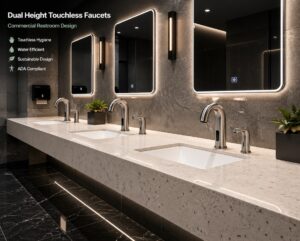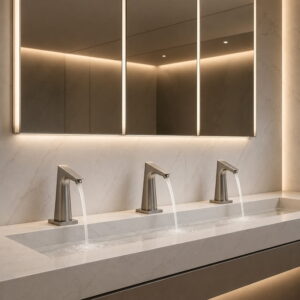

Touchless (sensor) faucets consistently reduce water use in high-traffic public restrooms by roughly 30–40% compared with standard manual faucets, largely because the flow automatically stops when hands leave the sensor field and because manufacturers pair sensors with low-flow aerators. These savings also lead to measurable reductions in hot-water energy use, lower utility bills, and—importantly for healthcare settings—improved perceived hygiene. However, the decision to install touchless systems requires capital and maintenance costs (such as sensor calibration, batteries or transformers, and solenoid valves), operational reliability, and infection-control requirements.
What The 2025 Evidence Shows
Multiple commercial case studies and manufacturer-collected audits from 2023–2025 show that facilities switching to touchless faucets typically experience a 30–40% reduction in water consumption. Airport implementations report similar results; several major airports have documented 30–40% water savings after combining sensor faucets with low-flow aerators. These reductions are driven by shorter run times per handwash and the automatic shut-off that occurs when users step away from the sink.
The U.S. Environmental Protection Agency (EPA) promotes low-flow faucet aerators as a proven way to reduce water use by 20% or more when faucets carry the WaterSense label, and sensor systems further amplify these savings in high-traffic public settings. Therefore, the most effective results are achieved when sensor activation is combined with WaterSense-level flow regulation.
Why Sensors Save Water — Mechanisms And Measurable Effects
Four mechanisms drive savings:
- Automatic shut-off — flow stops immediately after hands leave the sensor zone (eliminates “left-on” waste).
- Pre-set flow rates — most commercial sensor faucets ship with 0.35–0.5 gpm (gallons per minute) aerators vs older 1.2–2.2 gpm manual facets.
- Timed run limits — many sensors implement a max run time (e.g., 15–30s) to prevent prolonged misuse.
- Reduced behavioral leakage — users are less likely to leave touchless facets running while soaping or using phones. Together these produce the 30–40% reductions cited in audits.
Hospital Considerations: Hygiene Vs. Reliability
Hospitals prioritize infection control and staff workflow. Touchless faucets reduce direct contact with faucet handles—a plausible contributor to lower surface contamination and improved compliance with handwashing protocols. The CDC recommends best practices for handwashing and acknowledges that fixtures designed to reduce touchpoints can be beneficial in clinical environments, but it emphasizes that device reliability and ease of use are critical to avoid discouraging proper hand hygiene. Practical hospital deployment notes:
- Choose hospital-grade sensor faucets (manual override or stable default on/off behavior).
- Maintain a preventive maintenance schedule for sensor alignment, solenoid checks, and power (battery/transformer) replacements.
- Evaluate scald protection and temperature control for patient safety.

Airports And Large Transit Hubs: Scale Multiplies Benefit (And Risk)
Airports are high-throughput environments where small per-use savings scale into substantial utility reductions. Case audits show systemwide water savings of approximately 30–40% at several major airports when sensor faucets are combined with other efficient fixtures such as low-flow toilets and urinals. Benefits include lower water and energy bills, reduced HVAC load from decreased hot-water demand, and reduced wastewater volumes. Implementation risks:
- Sensors must be resistant to vandalism and robust to varied lighting/traffic patterns.
- Centralized power or easy battery replacement logistics reduce downtime.
- Real monitoring (metering by restroom or flight zone) is recommended to track real savings and spot faults.
Colleges And Campuses: Behavior + Retrofit Economics
Student and faculty restrooms can realize significant savings due to frequent short interactions. Savings are greatest where existing manual faucets are older, high-flow models. Campuses also benefit from educational messaging (such as signage showing water saved), which helps encourage proper use. For budget planning:
- Typical capital payback ranges widely depending on labor costs, water/energy prices, and faucet model; expect payback periods from 2 to 7 years in many cases (shorter where water or sewer costs are high). Manufacturer and case study ROI models often assume 30–40% water reduction.
Costs, Maintenance And Common Failure Modes
Costs: Higher upfront hardware and installation (sensors, solenoid valves, wiring) than manual faucets. However, utility savings and
reduced hot-water heating can offset capital over time.
Maintenance: Sensors require periodic cleaning and calibration; batteries or transformers need management; solenoids/valves may need
replacement after heavy cycling. Facilities teams should plan spares, simple troubleshooting guides, and vendor support contracts. Manufacturer
warranties and service-level agreements reduce long-term risk.

Practical Recommendation Checklist For Procurement Teams
- Audit current fixtures — baseline flow rates and usage counts per faucet.
- Pilot in one building/terminal/wing and meter water to confirm local savings.
- Specify WaterSense-rated aerators and hospital/airport-grade sensors.
- Include maintenance & monitoring clauses in procurement: battery schedules, spare parts, remote diagnostics where available.
- Train staff & post signage to prevent misuse and speed user acceptance.

Conclusion
According to data from 2025, touchless faucets are a scalable water and energy-saving solution that also supports hygiene objectives for hospitals, airports, and educational institutions. Careful product selection (flow rate + sensor quality), a phased deployment with metered verification, and a maintenance operations plan are all necessary for success. Expect measurable cost savings, typical water savings of 30 to 40%, and benefits in user perception and infection-control ergonomics when those components are in place.
Selected References & Resources
- FontanaShowers — Case Study: Touchless Faucets for Energy and Cost Savings.
- EPA WaterSense — Current guidance on water-efficient fixtures and aerators (2025).
- CDC — Clinical Safety: Hand Hygiene for Healthcare Workers (2024).
- Sloan (manufacturer) — Commercial sensor faucet product pages and water-savings features.
- Studies on airport restroom touchless technology — FontanaShowers summary (2024 audit data).
Why High-Traffic Facilities Benefit Most from Touchless Faucets
The biggest return from touchless faucet systems usually appears in high-traffic facilities where hundreds or thousands of handwashing events happen every day. In hospitals, airports, and university buildings, automatic shut-off helps reduce unnecessary water flow, while low-flow aerators keep usage controlled without making the fixture feel underpowered for daily use.
Beyond direct water savings, these systems also support lower hot-water energy demand, more consistent hygiene standards, and better long-term restroom management. For procurement teams, the most successful installations usually combine sensor reliability, efficient flow rates, and a clear maintenance plan so the faucets continue performing well after deployment.

Nadia Ellison is a staff writer and editorial team member at autotouchlessfaucets.com. Her work focuses on sensor faucet technology, activation methods, power options, and commercial applications, helping transform manufacturer documentation, product specifications, published standards, and industry sources into practical guidance for specifiers and facility professionals.