
A concise briefing for airline engineering, procurement, and product teams on why touchless lavatory systems matter, and how key supplier approaches compare in hygiene, passenger experience, and fleet integration.

What are touchless lavatory systems?
In an aircraft lavatory, a touchless system typically combines three elements: an infrared or ToF-sensor faucet, an automatic soap dispenser, and a compact, low-power hand dryer. Together, they reduce contact surfaces and standardize water and soap dosing per passenger.
Touchless Faucets
IR or proximity sensing with flow limitation and predictable run logic.
- Sensor activation with set run time and flow rate.
- Designed for tight monuments and shallow basins.
- Electrical and environmental constraints vary by program and integrator.
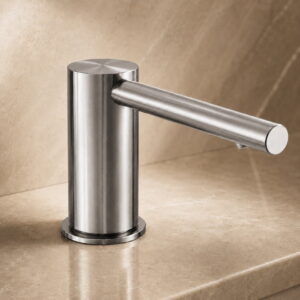
Touchless Soap Dispensers
Single-dose dispensing that reduces mess and surface contact.
- Controlled dosing to limit waste and sink contamination.
- Refill access integrated for crew servicing.
- Soap compatibility aligned to airline cleaning protocols.
Compact Hand Dryers
Low-power, low-noise drying designed for lavatory constraints.
- Often integrated to keep water inside the basin zone.
- Reduces paper storage and waste handling complexity.
- Requires careful airflow + noise coordination.
Why Touchless is Important to Airline Cabins
After comfort, the impact of rest room design translates to operational cost, customer perception, and building trust with the brand. Touchless technology had become the norm as the standard, no longer an upsell feature.
Hygiene & Safety
- Reduces contact with taps and dispensers that accumulate contamination.
- Supports visible “clean cabin” messaging.
- Helps standardize the passenger interaction.
Water & Resource Management
- Controlled flow time and rate reduce consumption per use.
- Lower risk of left-on flow or overflow events.
- Improves modeling of per-sector water demand.
Passenger Experience & Brand
- Modern lavatories influence perceived cabin cleanliness.
- Helps align older fleets with newer cabin expectations.
- Supports premium positioning with minimal layout impact.
Operational Uptime & Cleaning
- Fewer mechanical touchpoints reduce wear.
- Less cleanup between flights.
- Diagnostics, when available, can shorten downtime.

Leading touchless lavatory suppliers
Below is a high-level comparison of supplier approaches. Some focus on integrated touchless packages, while others deliver components or monument-level lavatory systems.
| Supplier / Program Type | Typical Role | Strengths | Integration Notes |
|---|---|---|---|
| Integrated touchless package | Faucet + soap + dryer coordination | Consistency, simplified sourcing, standardized UX | Confirm power, mounting, and maintenance access for the monument. |
| Component supplier | Faucet or dispenser modules | Flexibility, retrofit-friendly, replaceable subassemblies | Requires tighter coordination across vendors and interfaces. |
| Monument / lavatory integrator | Complete lavatory assembly | System-level validation and packaging | Lead times and certification constraints drive decisions. |
Technical resources
- Define flow targets and run-time logic for passenger use cases.
- Document power constraints and wiring access inside the monument.
- Specify maintenance access: battery replacement, refill routes, and quick swaps.
- Include acceptance tests for activation distance and false-trigger resistance.
Design Constraints Unique to Aircraft Touchless Lavatory Systems
Unlike standard commercial restrooms, aircraft lavatory systems operate under strict constraints related to weight, power availability, and space optimization. Touchless faucets and dispensers must be compact, lightweight, and capable of functioning reliably under vibration, pressure variation, and limited water supply conditions during flight.
For aircraft engineers and cabin designers, selecting touchless components involves balancing performance with integration requirements. Low-voltage DC systems (typically 12–28V), controlled flow rates, and durable sensor calibration are essential to ensure consistent operation across multiple flight cycles without increasing maintenance load or system complexity.

Nadia Ellison is a staff writer and editorial team member at autotouchlessfaucets.com. Her work focuses on sensor faucet technology, activation methods, power options, and commercial applications, helping transform manufacturer documentation, product specifications, published standards, and industry sources into practical guidance for specifiers and facility professionals.
You Might Also Like