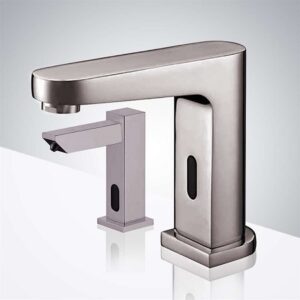


Touchless (automatic) faucets are now everywhere—from public bathrooms to hospitals, airports, and more. They promise cleanliness, water savings, and ease of use, but not all sensor faucets work the same way. We will discuss three measurable performance factors that can help you choose or evaluate touchless faucets: flow rate, sensor response (activation and shut-off behavior), and power efficiency. It references industry standards, laboratory tests, case studies, and manufacturer data to provide useful conclusions for facility managers and specifiers.
Why Measure These Three Metrics?
Flow rate determines water usage and user satisfaction (cleaning and rinsing capability). Sensor response affects both user experience and hygiene—slow or unreliable sensors can frustrate users or cause unnecessary contact. Power efficiency matters operating costs and battery-powered units installed where AC power is inconvenient. Together, these metrics answer the question: Will the faucet save water, work reliably, and cost little to operate?
Flow Rate — Expected Performance and Actual Savings
Low-flow aerators are commonly installed in modern public restroom sensor faucets. Regulatory and guidance documents outline typical performance targets: kitchen or service faucets generally range from 1.5 to 2.2 gpm depending on their intended use, while public restroom faucets are typically ≤0.5 gpm, or about 1.9 L/min. Although lower flow rates clearly save water, if the flow is too low for the task, rinsing performance may be compromised.

Empirical research shows that combining optimized sensor logic with the right aerator selection can significantly reduce water use. In a field study at Sacramento State, automatic faucets equipped with 0.5 gpm and 0.35 gpm aerators were compared with manual faucets. The results showed average water reductions of approximately 32% (0.5 gpm) and 54% (0.35 gpm) compared to manual fixtures, demonstrating that automatic faucets paired with ultra–low-flow aerators can substantially reduce consumption in high-use public environments. However, if sensor timing is not properly adjusted, very low flows (e.g., ≤0.35 gpm) may cause users to repeatedly trigger or hold their hands under the faucet, potentially offsetting some of the savings.
Sensor Response — Activation Speed, Detection Reliability and Shutdown Behavior
Sensor response has two components: activation latency (how quickly water starts after hands enter the sensing zone) and shutdown logic (the automatic shutoff delay and the robustness of presence detection).
In terms of technology, lower-cost units typically use basic infrared (IR) proximity sensors, mid-range models use refined IR with digital filtering, and higher-end faucets employ Time-of-Flight (ToF) or ultrasonic sensing for faster, more reliable detection under complex lighting or reflective surfaces. ToF systems generally deliver the quickest activation times and the fewest false triggers.
What numbers matter? For a good user experience:
- Activation latency: ≤100 ms is ideal; many high-quality units achieve 20–200 ms, depending on the sensor technology and manufacturer specifications. Faster reaction times reduce the user’s urge to touch the spout. Some manufacturers disclose response times—premium models, for example, claim activation in less than 0.05 seconds.
- Shutoff timeout: For single activations, solenoid or ecology timers typically shut off five to ten seconds after the last detection; some units allow a configurable “presence” hold to maintain continuous flow while hands remain in the sensing zone. Shorter timeouts reduce water waste but may risk shutting off too soon while users are still rinsing.
Field notes:
- Poor sensor placement—such as mounting the sensor too high, too low, or positioning it where it is obstructed by soap dispensers—can lead to false negatives. Always test the faucet in its actual installation environment.
- Reflective chrome surfaces or strong ambient sunlight can interfere with IR sensors; Time-of-Flight (ToF) sensors or well-shielded IR emitters help minimize these issues.

Power Efficiency — Batteries, AC Options, And Lifecycle Cost
Most touchless faucets are powered by replaceable batteries (commonly AA or D-cell packs), rechargeable battery modules, or AC line adapters. Power draw is minimal when idle; the main energy consumers are 1st the sensor electronics’ standby current and 2nd the solenoid valve actuation during each dispensing event.
Published guidance and product manuals show:
- The idle currents for efficient sensor-.module combinations can vary from microamperes to low milliamperes, and low-power designs can support very long lifetimes from batteries with periods measured in months to years.
- Although the time the energy takes to activate a solenoid takes a short time, its importance cannot be underestimated. Batteries have a tendency of draining fast, especially in busy environments such as airports, unless AC power and large battery systems are involved.
Lifecycle tradeoffs:
- Battery-powered faucets are easy to retrofit and avoid wiring, but they require scheduled battery replacement and generate waste. In moderate-use settings (offices, small retail), battery life can last several months; in high-use locations (airports, hospitals), it may drop to just a few weeks.
- AC-powered faucets reduce maintenance but increase installation costs, require protected wiring, and often need an isolation transformer. Hybrid systems (battery + AC) or low-voltage DC designs with smart power management are becoming increasingly common.
Recommendation: for high-traffic public environments, specify AC or hardwired low-voltage units. For retrofits or low-traffic areas, battery-powered faucets are acceptable if they use high-efficiency sensor modules and include a planned battery maintenance program. Reference product power specifications and conduct pilot tests to estimate battery replacement intervals.
Putting It Together — Spec Checklist For Buyers
- Flow rate: Target 0.5 gpm for public lavatories and 1.5 gpm for kitchens, unless rinsing requirements justify higher flow. Use WaterSense and ASME guidance as a baseline.
- Sensor tech & response: Require documented activation latency (preferably <100 ms), a configurable detection zone, and Time-of-Flight (ToF) or advanced IR sensors for high-traffic sites or areas with variable lighting.
- Shutoff logic: Ensure the faucet has an adjustable timeout and anti-stiction logic to prevent continuous drift or false triggers.
- Power: For sites with more than 500 uses per day, choose hardwired or AC-powered units. For fewer than 200 uses per day, high-efficiency battery-powered faucets are acceptable. Request manufacturer specifications for energy per actuation and idle current.
- Maintenance & testing: Pilot a sample installation to measure actual flow rates, battery life, and user acceptance before proceeding with a full rollout.
Conclusion
While performance will depend on the specific aerator used, sensor type, and power system, automatic touchless faucets can offer water savings as well as enhanced hygienic conditions. In this regard, one can turn to published research on field performance, product literature, as well as recognized WaterSense and ASME standards for guidelines on performance criteria. In high-use applications, emphasis should be on high-performance sensors with high-resolution ToF/IR, hardwired power systems, and 0.5 GPM aerators. In lower-use applications with retrofits, battery faucets with efficient sensors and 0.5 GPM aerators are appropriate. Pilot testing remains the most reliable way to verify performance for your specific site.
References
- Sacramento State field study — automatic faucets with 0.5 and 0.35 gpm aerators showed ~32% and ~54% water reductions vs manual.
- EPA WaterSense — guidance on flow rates and commercial lavatory faucet recommendations.
- U.S. Department of Energy (FEMP) Best Management Practice for Faucets and Showerheads — recommended flow targets and retrofit guidance.
- ASME/technical guidance and plumbing standards — flow rate limits for public faucets (ASME A112.18.1 and related tech notes).
- Sensor technology and manufacturer notes (ToF vs IR, response claims). Manufacturer product pages and market reviews.
Why Real-World Testing Matters for Touchless Faucet Performance
Published specifications are useful, but actual touchless faucet performance depends on the installation environment, user traffic, sensor calibration, and power setup. A faucet that performs well in a product sheet may behave differently in a busy airport restroom, hospital wash station, or office lavatory where lighting conditions, reflective surfaces, and repeated daily use affect activation speed and shutoff reliability.
For facility managers, engineers, and commercial buyers, the most effective approach is to compare flow rate, sensor response, and power efficiency together rather than in isolation. A well-balanced touchless faucet should deliver stable activation, controlled water use, and low maintenance demand while still giving users a smooth handwashing experience in high-traffic settings.

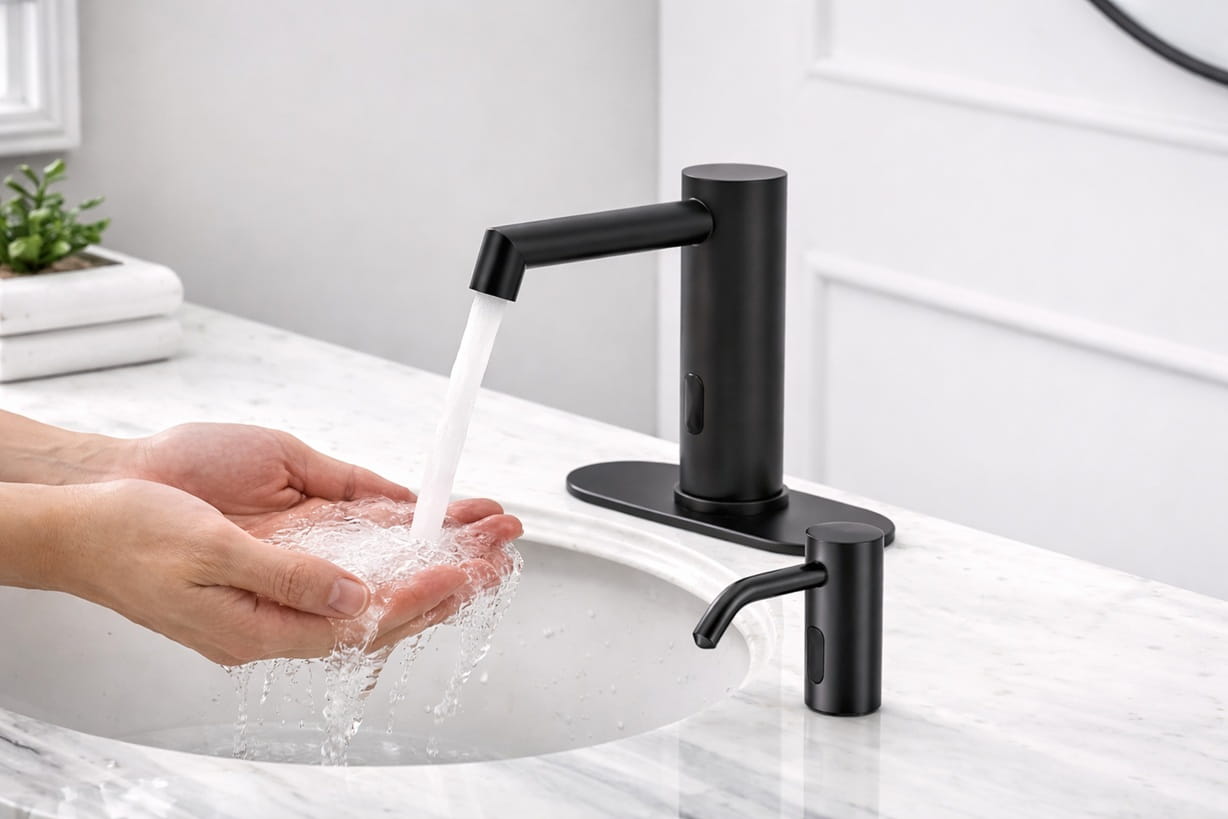
Commercial touchless faucet setup illustrating sensor performance, water control, and high-traffic restroom application.

Nadia Ellison is a staff writer and editorial team member at autotouchlessfaucets.com. Her work focuses on sensor faucet technology, activation methods, power options, and commercial applications, helping transform manufacturer documentation, product specifications, published standards, and industry sources into practical guidance for specifiers and facility professionals.