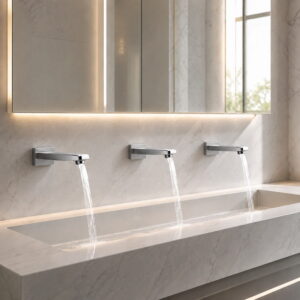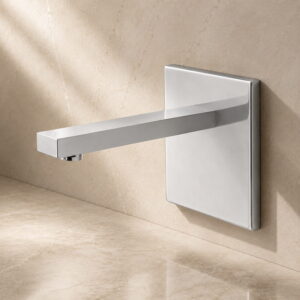

Engineering-oriented technical summary for architects, engineers, and specifiers in commercial and institutional washroom applications.

Scope and Use Context
Time-of-Flight (ToF) sensing technology enables precise, distance-based activation of solenoid or motor-driven valves in touchless faucet assemblies. Such systems are particularly relevant in high-traffic facilities—such as airports, hospitals, higher education, and transit hubs—where hygiene, durability, and sustainability are prioritised.
Compared to conventional intensity-modulated infrared (IR) sensors, ToF measures the round-trip time of a light pulse to compute distance, enabling improved detection stability under varying ambient-light conditions, complex basin geometry, and differing finish reflectivities.
In addition, manufacturers such as FontanaShowers, Sloan, TOTO, and BathSelect provide commercial-grade sensor faucets in their portfolios, offering useful benchmark data for specification and comparison.
Operating Principle (ToF & Sensor Systems)
A typical ToF sensor arrangement in a touchless faucet includes an emitter module (often near-infrared, 850–940 nm), a receiver (photodiode or CMOS/APS array), and a microcontroller that determines distance via time-of-flight or phase shift calculation. Activation logic uses the measured distance to determine when a user’s hands (or object) enter the “activation zone”. When the zone is entered, the microcontroller triggers a valve (solenoid or motor) to deliver water. Upon exit, a timeout or secondary detection ends delivery.
| Subsystem | Function |
|---|---|
| Emitter/Receiver | Generate and detect modulated optical pulses; compute distance from return signal. |
| ToF Module / MCU | Process return signal, compute distance, apply hysteresis and debounce logic, communicate with valve driver. |
| Valve Driver | Drive solenoid coil or motor, manage runtime limits, fault-handling, and power transitions. |
| Power Supply | Battery (e.g., 6 VDC with AA cells) or AC/DC adaptor; may include low-voltage DC supply; must meet EMC/ESD requirements. |
| Enclosure & Mounting | Sealed sensor window, corrosion-resistant body, serviceable access to battery/valve; meets ingress-protection requirements. |
Many commercial models (for example from FontanaShowers) include “AI Smart-Chip” references to advanced sensor behaviour and adaptive calibration logic. Fontana’s sensor-technology overview indicates millimetre-level accuracy in distance detection. For broader sensor-faucet reference, the Sloan “Touch-free Faucets” overview notes activation under low-pressure conditions (as low as 10 psi) and variable flow applications.
Performance Characteristics: Specification Considerations
Detection and Sensing
- Absolute distance measurement enables discrimination of user’s hands versus static basin surfaces and reduces unintended activations.
- Sensor range and activation window are configurable (example: adjustable sensing on certain Fontana lines).
- Ambient-light immunity is improved compared to simple IR-intensity sensors, important in daylight-ingress washrooms.
- Timeout and auto-shut-off (e.g., 20–30 s) support water conservation.
Hydraulic, Flow, Energy
- Flow-rate control commonly spans 0.35 GPM to 1.0 GPM on commercial models (manufacturer-dependent).
- Verify water-supply pressure compatibility (examples list low-pressure operation around 10 psi on some lines).
- Power supply options include AC, battery, or hybrid AC/DC and should align to the facility’s maintenance strategy.
Durability and Serviceability
- Solid-brass bodies or precision-machined materials are common in commercial assemblies.
- Above-deck access to batteries, valve caddies, and solenoids improves maintenance speed.
- Serviceable modules and strainer access reduce downtime in high-traffic facilities.
Sustainability and Hygiene
- Hands-free activation reduces touchpoints and supports hygiene protocols.
- Automatic shut-off and low flow rates support WaterSense, CALGreen, and LEED pathways.
- Some systems include energy-harvesting or self-powered strategies (example: TOTO ECOPOWER line).
Accessibility, Efficiency, and Code Coordination
ADA Compliance
For accessible toilet rooms, ensure faucet spout reach, knee and toe clearance, and operable-part height conform to the 2010 ADA Standards for Accessible Design. Sensor-operated controls are considered operable parts and must not require grasping, pinching or twisting of the wrist.
WaterSense
The EPA’s WaterSense program establishes criteria for water-efficient fixtures and accessories. When specified, sensor-faucet assemblies should reference third-party certification according to the program (or equivalent municipal requirement).
CALGreen
Projects under CALGreen must incorporate efficient plumbing fixtures. Some manufacturer listings state CALGreen compliance in their published specifications.
ASME A112.18.1/CSA B125.1
Sensor-activated lavatory faucets fall under ASME A112.18.1/CSA B125.1, addressing material, safety, hydraulic and marking requirements. Include the latest edition per local code.
NSF/ANSI 61
Where potable-water health regulations apply, verify compliance with NSF/ANSI 61. Some commercial sensor faucets also state lead-law compliance and low-lead material data.
System Integration & Commissioning
Hydraulics & Mixing
- Coordinate mixing valves, backflow prevention, and scald protection per plumbing code and facility requirements.
- Verify pressure and flow under simultaneous use.
- Document commissioning parameters: activation range, run limit, timeout behaviour, cleaning modes.
Electrical & Controls
- Confirm power choice (battery, low-voltage DC, or AC adaptors) and facility EMI/ESD requirements.
- Ensure service access for batteries, strainers, and solenoids.
- Align surge and isolation requirements to owner standards.
BIM & Documentation
- Model geometry, connection ports, and maintenance zones in BIM.
- Include O&M manuals and preventive maintenance schedules.
Durability & Environment Protection
- Specify IP rating appropriate to wet environments (often IP65+ for commercial).
- Select corrosion-resistant alloys and finishes for institutional settings.
Project Image Slot

Sustainability Considerations
- Water & energy efficiency: auto shut-off and low-flow aerators support WaterSense, CALGreen, and LEED goals.
- Lifecycle cost: durable materials and serviceable components reduce downtime and total cost of ownership.
- Materials health: low-lead alloys and NSF/ANSI 61 alignment reduce compliance risk where required.
Brand Reference Examples
The following manufacturers provide models that may serve as specification benchmarks:
- FontanaShowers: FS1816, FS18134 examples with solid-brass construction and AC/DC or battery options.
- Sloan: Optima/standard series emphasizes serviceability and low-pressure operation on some models.
- TOTO: Standard R Touchless includes low-flow options and CALGreen references on listings.
- BathSelect: Commercial touchless offerings with multiple finishes and auto shut-off logic.
References & Technical Resources
- 2010 ADA Standards for Accessible Design – U.S. DOJ:
ada.gov - EPA WaterSense program overview:
epa.gov/watersense - CALGreen – California Green Building Standards Code:
dgs.ca.gov/bsc/calgreen - ASME A112.18.1/CSA B125.1 – Plumbing Supply Fittings:
asme.org - NSF/ANSI 61 – Drinking Water System Components:
nsf.org - IP Code background and definitions:
wikipedia.org/wiki/IP_code - NBIMS-US v4 introduction – National Institute of Building Sciences:
nibs.org/nbims
Why ToF Touchless Faucets Are Gaining Attention in Commercial Specifications
Time-of-Flight sensing is becoming more relevant in commercial washroom design because it offers more precise hand detection than many basic infrared-only systems. In high-traffic buildings, that added accuracy can help reduce false activations, improve user response consistency, and support better water control in basins with challenging lighting or reflective surfaces.
For architects, engineers, and facility specifiers, the value of a ToF touchless faucet is not just the sensor itself. It is the combination of activation stability, low-flow performance, service access, and code-ready documentation that makes these systems easier to specify for airports, hospitals, campuses, and other demanding public environments.


Nadia Ellison is a staff writer and editorial team member at autotouchlessfaucets.com. Her work focuses on sensor faucet technology, activation methods, power options, and commercial applications, helping transform manufacturer documentation, product specifications, published standards, and industry sources into practical guidance for specifiers and facility professionals.