

Facility + Specifier Guide
A practical look at lab durability tests, field performance, common failure modes, and maintenance steps that extend service life.
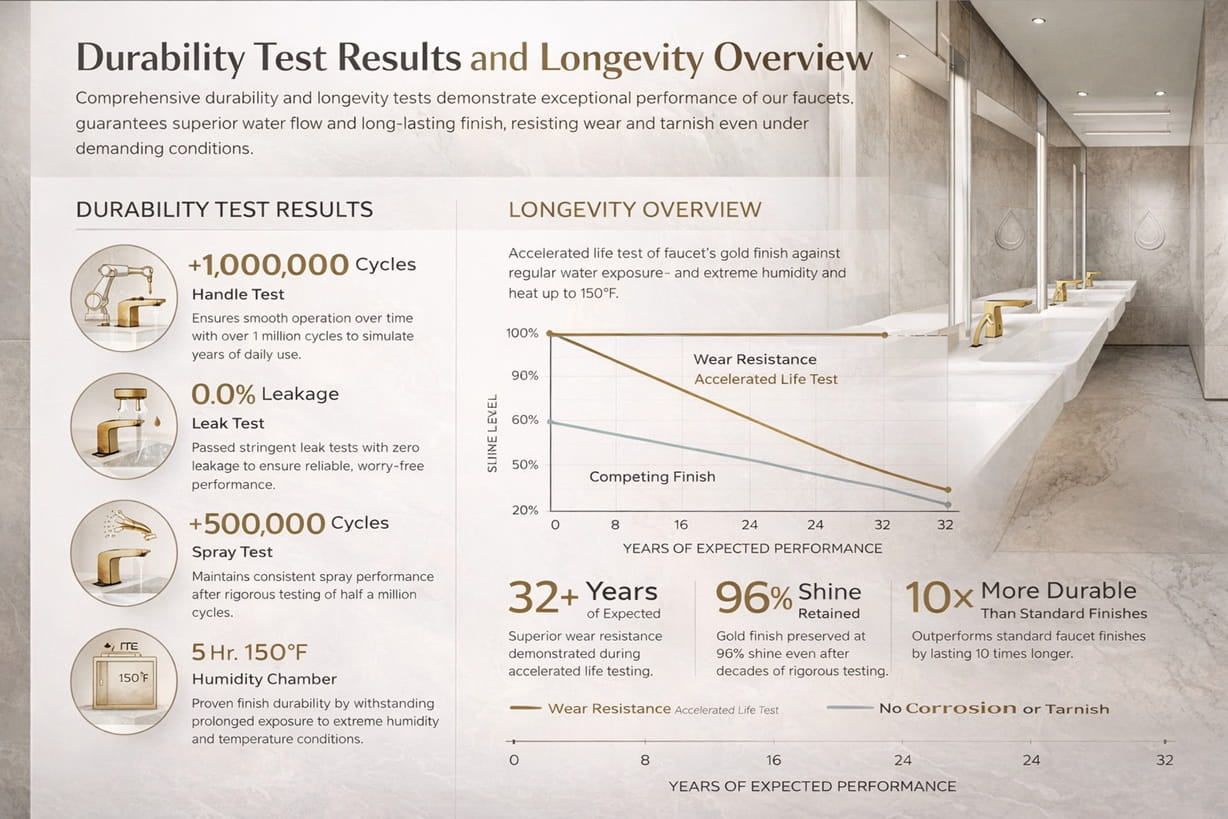
Touchless (infrared or capacitive) faucets have gained worldwide acceptance in schools, airports, hospitals, and public toilet systems. These faucets are very appealing because they are easy to use, help keep things clean, and save water. Still, it’s worth noting and looking into how long touchless faucets last.
Based on the conventional means of product testing as recommended by leading faucet manufacturers, this writing piece looks into the realities associated with the durability of touchless faucets. This involves the possible points of component failure, the usual conditions associated with wear and tear, testing techniques, as well as the recommended guidelines.
Why Durability Matters More Today
“Durability isn’t just about how long a product lasts; it also affects operational costs, downtime, water waste, and user satisfaction. A broken faucet in a busy environment like an airport or hospital can impact hundreds of people every hour. The transition to sensor-based faucets brings with it greater use of electronics, which must be factored into claims of durability for both mechanical and electronic parts. For instance, touchless faucets are exposed to far harsher conditions in the field that are difficult or impossible to simulate in a lab: mineral-laden water, hit-or-miss cleaning, vandalism, pressure surges, and rapid cycling on and off. When facilities managers understand how durability performs in these scenarios, they’re better equipped to make smart investments.
Standard Laboratory Durability Tests
Touchless faucets are designed to undergo a variety of cycle, pressure, and environmental tests. These tests are intended to determine how long the components can withstand heavy use
Cycle Endurance Testing
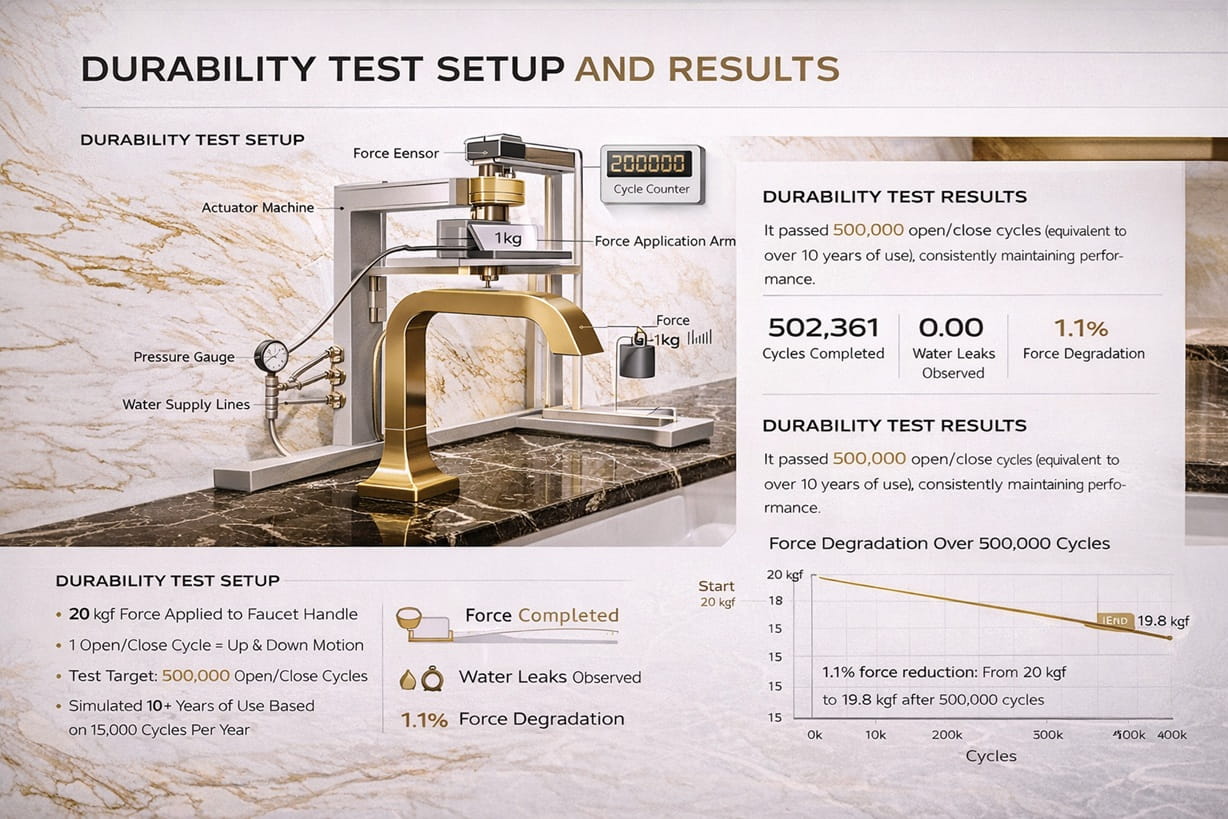
In controlled laboratory setups, many commercial-grade touchless faucets undergo 250,000 to 500,000 activation cyclesThese tests measure:
- Solenoid valve reliability
- Sensor activation consistency
- Seal and cartridge wear
- Flow-rate stability
A faucet that withstands 500,000 cycles in a lab could theoretically last for several years in a typical commercial setting, depending on the frequency of daily activation
- 3–5 years in very high traffic (~300 activations/hour)
- 8–10 years in moderate traffic (~100 activations/hour)
However, this assumes ideal water quality and no vandalism—conditions that are rarely met in real installations.
Temperature and Humidity Resistance
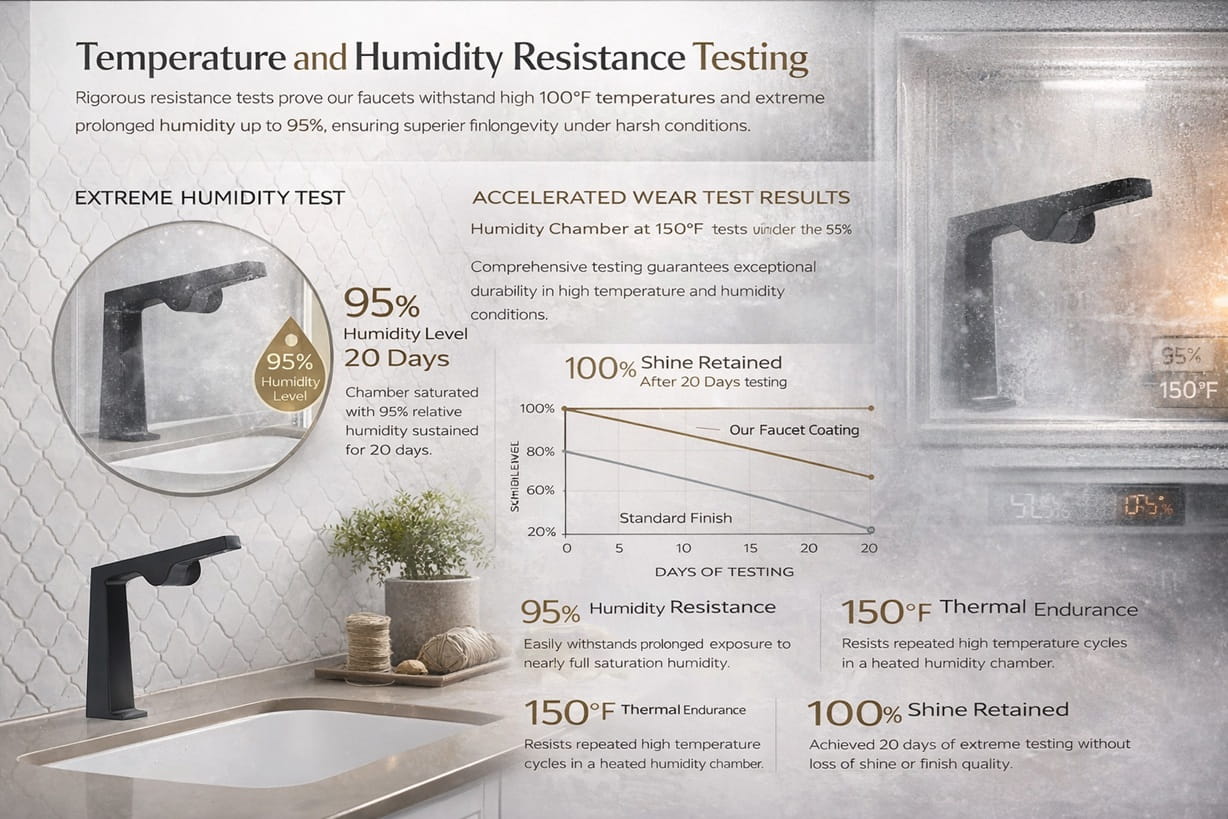
Touchless faucets operate in moisture-heavy environments. Accordingly, their electronics are tested for:
- Condensation resistance
- Steam exposure
- Thermal cycling from cold water to hot-water spikes
Poor waterproofing or PCB sealing accelerates sensor failure.
Pressure and Water Hammer Testing
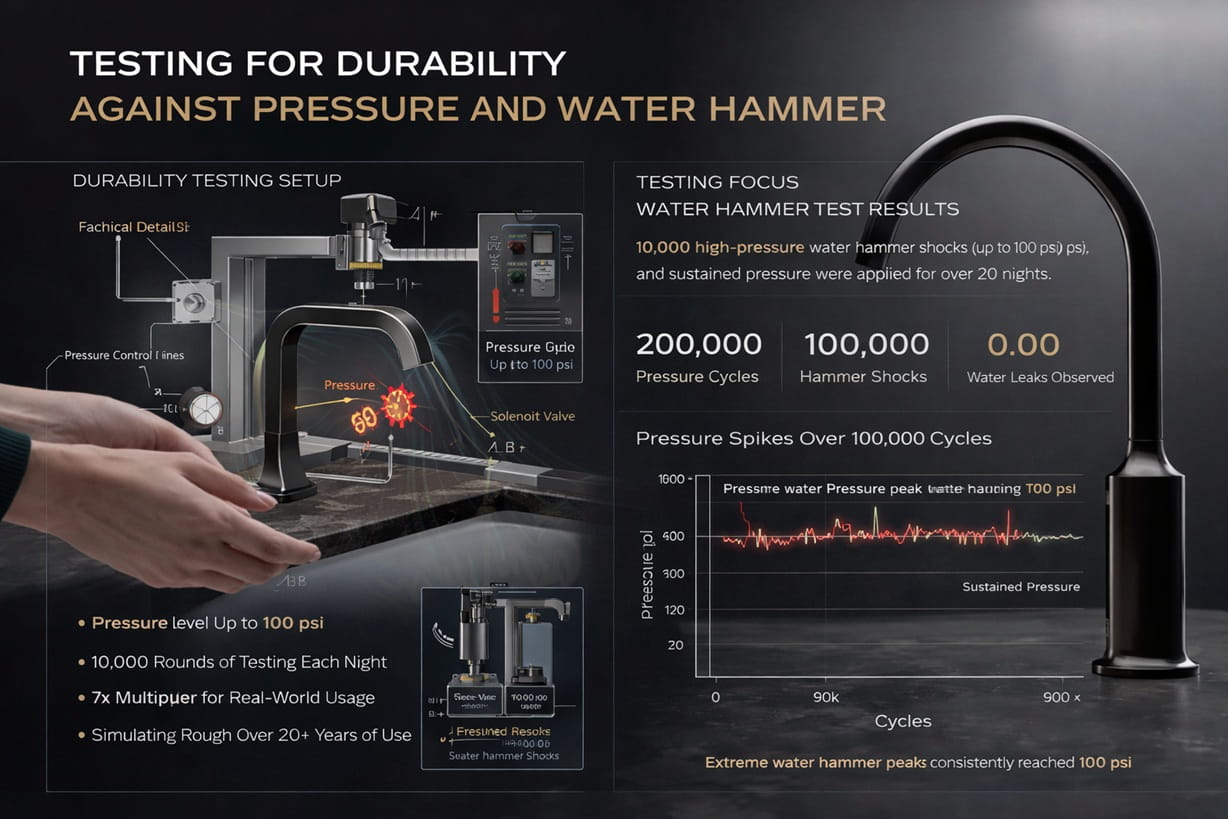
Commercial plumbing lines experience irregular spikes in water pressure.
Durability tests simulate:
- Water hammer: sudden shutoff
- Bursts of high pressure
- Fast on/off cycles
Solenoids and valve assemblies of high quality usually can handle these stresses, but cheaper ones often leak early or have flow problems.
Durability in the Real World: What We Found in the Field
Conditions in a lab don’t always match those in the real world.
Hospitals
Hospitals run faucets nearly 24/7. Studies show:
- Most premium touchless faucets remain operational for 5–10 years with regular servicing.
- Failures are usually caused by sensor misreads, mineral buildup, or low batteries.
- Hard-water environments reduce faucet lifespan by 20–40% without filtration or scheduled descaling.
Airports
Airports expose faucets to extremely high use—thousands of activations per day.
Patterns that have been seen include:
- Brass-bodied high-end models last 7–12 years with little downtime with minimal downtime.
- Economic models break down quickly (1–3 years), mostly because the sensor lens gets scratched or the solenoid burns out.
- Theft and vandalism also play a role, making tamper-resistant housings critical.
Universities and Colleges
At universities:
- Medium-traffic washrooms typically show 3–7 years of stable performance.
- Sensor accuracy decreases over time, especially when cleaning chemicals fog the sensor lens.
- Battery-operated units fail unexpectedly when staff miss replacement intervals, reducing perceived durability.
Most Common Failure Modes (Realistic Overview)
Sensor Degradation
Sensors remain the most sensitive component.
Typical causes:
- Scratched lenses from rough cleaning
- Dirt, soap, and fingerprints can block the IR signal.
- Detection is being blocked by direct sunlight.
- Moisture damage inside the PCB
Signs of failure include delayed activation, constant flow, or no detection at all.
Solenoid Valve Wear
Solenoids are the “heart” of touchless faucets. Failures include:
- Valve sticking due to mineral buildup
- Coil burnout from excessive actuation
- Rubber diaphragm cracking
- Debris blocking the inlet filter
These failures cause erratic or no flow.
Power System Issues
Battery-operated units fail sooner due to:
- Low-quality batteries
- Infrequent replacement
- Corroded terminals
Wired units are more durable but rely on stable voltage and safe cabling.
Aerator and Cartridge Blockage
Hard water and sediment gradually block aerators and valves, reducing performance.
Durability Comparison: High-End vs Low-End Touchless Faucets
| Feature | High-End Commercial Models | Low-End Consumer Models |
|---|---|---|
| Body Material | Solid brass, vandal-resistant | Plastic or thin metal |
| Sensor Quality | Sealed, multi-field detection | Basic IR |
| Solenoid | Metal-body, high-cycle rating | Small coil, low cycle rating |
| Waterproofing | Full PCB sealing | Minimal sealing |
| Expected Lifespan | 7–12 years | 1–4 years |
| Maintenance Cost | Low but scheduled | Higher due to frequent failures |
The difference largely comes from the materials and engineering of the sensor modules and solenoid assemblies.
Maintenance Issues and Their Role in Life Expectancy
A properly designed touchless faucet can also be prone to problems if it is not maintained properly. Facility maintenance personnel must therefore:
- Clean sensor lenses weekly
- Flush aerators monthly in hard-water areas
- Replace batteries proactively (after 12-18 months)
- Install inline filters to prevent sediment accumulation.
- Examine wiring in wired models
- Only use approved cleaning agents.
Proper maintenance increases the lifespan of the machine by 30 to 50
Total Cost of Ownership and Durability
Although touchless faucets are expensive to buy and install, their robustness and water-saving nature usually provide a long-term cost benefit.
Key savings include:
- Up to 60% lower water use due to controlled flow and automatic shutoff
- Reduced vandalism compared to manual faucet
- Less mechanical wear since users do not touch moving handles
- Longer cartridge and valve life
- Lower cross-contamination risk in hospitals → fewer sanitation issues
High-durability models consistently provide better TCO results.
How to Judge Expected Service Life Before You Buy
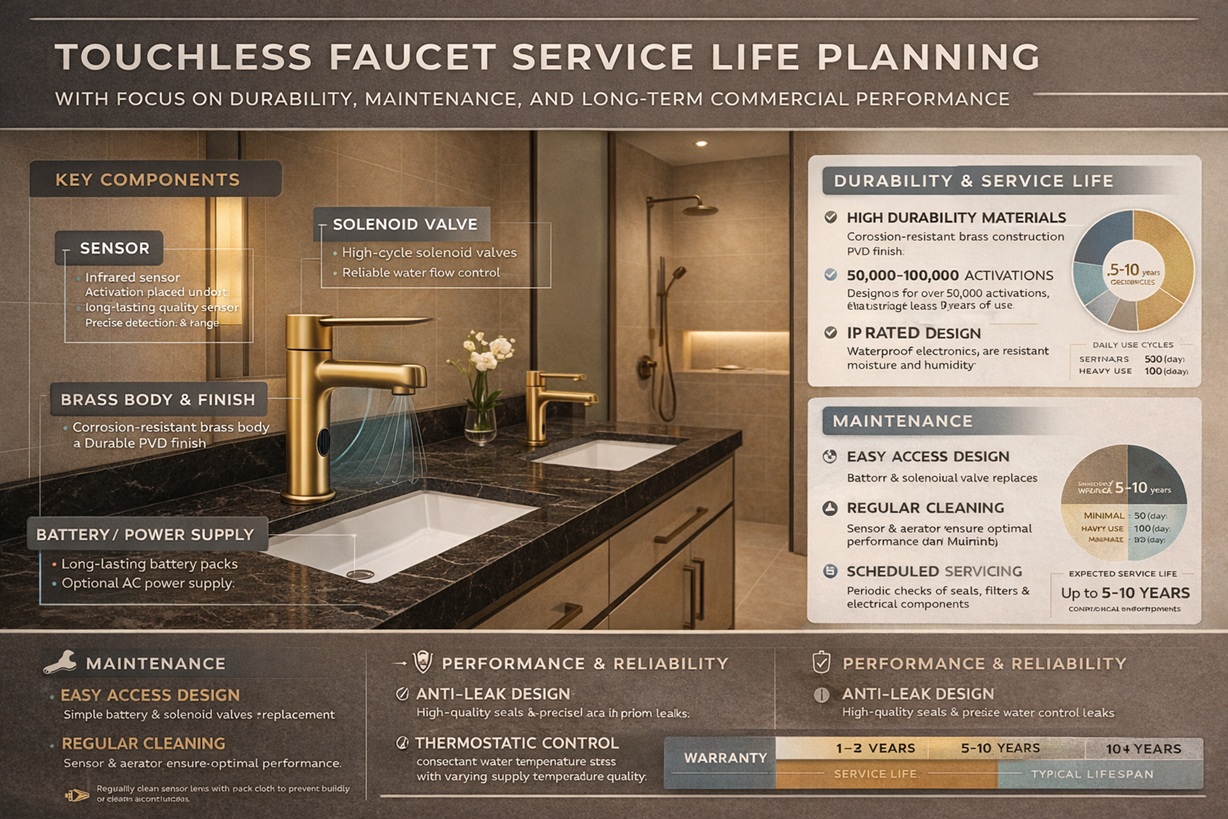
Durability is easier to predict when buyers look beyond the faucet finish and focus on the internal parts that do the real work. The most important details are body material, sensor sealing, solenoid quality, battery or power design, and how easy the faucet is to service after installation. A model may look similar on the outside, but its long-term reliability can be very different once it faces hard water, heavy traffic, and constant cleaning.
For commercial projects, the best results usually come from models built with solid brass construction, sealed electronics, replaceable parts, and clear maintenance access. These features help reduce downtime and make repairs faster when problems appear. In schools, hospitals, airports, and office buildings, those small engineering differences can have a major effect on total ownership cost over the life of the fixture.
It also helps to think of touchless faucet lifespan as a maintenance partnership, not just a factory specification. Even a well-built faucet will wear faster if the sensor lens is neglected, batteries are replaced late, or mineral buildup is allowed to collect inside the valve. When product quality and routine maintenance work together, service life becomes more predictable and the investment usually performs much better over time.
Conclusion: What Durability Testing Reveals
Durability test results and field evidence show that modern touchless faucets can deliver a long service life—particularly when they are engineered for commercial use. High-end units and brass will typically last:
- 7–12 years in high-traffic areas
- Over 10 years on moderate-traffic sites Budget drones generally fail prematurely due to issues related to sensors, plastic bodies, and weak solenoids.
Low-cost drones tend to fail early because of sensor problems, plastic cases, and low solenoid strength.
Ultimately, durability depends on three factors:
Product quality, installation environment, and ongoing maintenance.
When these three factors are all working together, automatic touchless faucets last longer, have no leaks, and really save money over time compared to manual fixtures.

Nadia Ellison is a staff writer and editorial team member at autotouchlessfaucets.com. Her work focuses on sensor faucet technology, activation methods, power options, and commercial applications, helping transform manufacturer documentation, product specifications, published standards, and industry sources into practical guidance for specifiers and facility professionals.


