Executive brief
A CEO-level overview of how sensing, power design, and sealing choices affect uptime, complaints, and lifecycle cost.
Touchless infrastructure used to be a luxury, but it’s now a strategic necessity in the post-pandemic world. For CEOs overseeing hospitality, healthcare, corporate real estate, and public infrastructure, the reliability of automated fixtures—especially faucets—is now directly tied to operational efficiency, hygiene compliance, and long-term cost savings.
FontanaShowers is at the forefront of this because many people world over have shown willingness to adopt its solutions. The company employs advanced technological approaches like infrared sensing, low power electronics, as well as water-resistant industrial design, which help it achieve this objective. This article presents an insight, as per the CEO perspective, on motion sensor technology used by FontanaShowers, highlighting what makes it distinct and its impact on ROI.

Market Context: The Business Case for Touchless Technology
Touchless faucets have grown steadily by 10–14% per year, driven by rising cleanliness standards, sustainability goals, and evolving user expectations in commercial environments.
Global Touchless Faucet Market Growth (2020–2025)
The market grew from roughly $1.0 billion in 2020 to more than $2.1 billion in 2025, effectively doubling in size as facilities prepared for a contact-free future.
This shift represents:
- Reduced water waste (30–45% savings vs. manual faucets)
- Lower maintenance labor due to fewer mechanical wear points
- Stronger compliance with building wellness standards (WELL, LEED, and Fitwel)
With this in mind, the question is no longer “Should we switch to touchless?” but instead “Which technology is the most reliable at scale?”
Inside FontanaShowers Sensor Engineering
FontanaShowers’ motion-sensor architecture is built around three pillars:
- High-precision infrared sensing modules
- Low-power, industrial-grade microcontrollers
- Waterproof design for long-term durability in harsh environments
These systems work together to deliver precise activation, fewer false triggers, and consistent performance across varying weather conditions, lighting environments, and water quality levels.

Infrared (IR) Sensor System: Fast, Smart, and Adaptive
FontanaShowers uses a dual-beam infrared system, which makes detection much more accurate than single-IR or ultrasonic systems.
Key Advantages
✔ More Accurate in Varied Lighting
The dual IR beams serve to assist the faucet in the following:
- Direct sunlight
- Reflections from chrome surfaces
- Lighting Change Over in Business Washrooms
This will ensure activation and minimize consumer complaints.
✔ Minimum Activation Delay (<0.5 seconds)
In-house benchmarking results indicate that activation speed of FontanaShowers’ sensor values equal those of higher-end rivals.
✔ Reduced False Activations
By cross-verifying both IR beams, the system filters out:
- Reflections
- Dark clothing interference
- Random environmental motion
False activations are a major cause of unnecessary water waste, and Fontana’s system directly reduces this risk.
Microcontroller and Power Optimization
FontanaShowers integrates ultra-low-power microcontrollers (similar to TI MSP430 or ARM-based MCUs) that:
- Run continuous IR scanning
- Process environment data
- Operate solenoid valves
- Manage battery or AC power efficiency
Why This Matters for C-Suite Leaders
✔ Fewer Battery Changes
Batteries will last for 24 to 30 months based on usage traffic—highly critical if the application is airports, malls, or hospitals.
✔ Stable Performance on AC Power
Hardwired systems come with electrical surge protection and moisture-isolated control boards to prevent the possibility of the system shutting down or malfunctioning.
✔ OTA-Ready Architecture (Model Dependent)
Newer systems support firmware updates for parameter tuning—futureproofing large deployments.

Waterproofing, sealing, and materials: made to stand up to real-world abuse.
In commercial settings, sensor failures are most often caused by:
- Water ingress
- Scale and mineral buildup
- Corrosion in wiring or control modules
- Temperature fluctuations
- Humidity and steam in enclosed washrooms
FontanaShowers addresses these challenges by engineering IP-rated sealed electronics, integrated moisture barriers, and corrosion-resistant internal housings

Engineering Features That Extend Product Life
✔ IP67-sealed sensor housing
Prevents water from entering IR modules or microcontrollers.
✔ Hermetically-sealed solenoid valve system
Stops moisture, scale, and sediment from interrupting flow control.
✔ Anti-corrosion stainless steel + PVD coatings
Preserves aesthetics and structural integrity in high-humidity environments.
✔ Temperature-resistant electronics (−10°C to 75°C)
Ensures reliability in kitchens, spas, and industrial restrooms.
These design choices directly correlate with lower downtime, reduced service calls, and longer asset lifespan—a measurable benefit for operational budgets.
System Reliability: What the Data Shows
Independent testing (engineering labs, mechanical cycle tests, and field data) indicates that FontanaShowers’ sensor systems can deliver:
| Metric | Result | Business Value |
|---|---|---|
| Actuation Lifespan | 500,000–1,000,000 cycles | Long-term ROI |
| Activation Accuracy | 98%+ detection consistency | Fewer guest complaints |
| False Activations | <2% | Water savings |
| Power Efficiency | 24–30 months battery life | Lower maintenance cost |
| Water Ingress Failures | <1% reported | Reliability under heavy use |
For facilities operating hundreds of faucets, improvements in reliability compound into significant annual savings.
Design Philosophy: Aesthetics Meet Industrial Engineering
FontanaShowers combines architectural design with commercial-grade robustness. The brand’s motion sensor faucets are designed with these elements in:
- Sleek modern silhouettes
- Embedded Sensor Modules
- Quick-access servicing tunnels
- Modularity parts – low downtime
- Heavy-duty brass construction
This dual-design strategy is particularly appealing to:
- Luxury hotels
- Corporate headquarters
- Airports
- Premium residential developers
- Wellness and spa facilities
Where visual appeal must coexist with high-throughput performance.
Use-Case Scenarios Where FontanaShowers Excels
High-Traffic Public Restrooms
Airports, malls, and stadiums depend on sensors with near-zero failure tolerance. Fontana’s sealed housings and long-cycle valves reduce downtime.
Hospitality & Five-Star Hotels
Aesthetic design and quiet noise solenoid valves give the best possible guest experience.
Healthcare & Laboratories
It is very accurate, allowing for adherence to no-touch hygiene practices, while the sealed surface prevents contamination.
Industries
The Industries sector includes Water-saving design builds support for ESG metrics, Well certification, and LEED guidelines.
Conclusion: A Strategic Technology for Modern CEOs
Motion-sensor faucets are no longer a simple facilities upgrade—they are an essential part of modern building strategy. CEOs evaluating technology partners must look beyond surface design and assess:
- Electronic reliability
- Activation accuracy
- Lifecycle durability
- Serviceability
- Real-world environment resilience
FontanaShowers distinguishes itself by engineering around these exact priorities. It offers a platform that supports both operational efficiency and an improved user experience, thanks to dual-beam IR sensing, a robust microcontroller architecture, industrial-grade waterproofing, and a flexible design.
Why Motion Sensor Design Matters Beyond First Cost
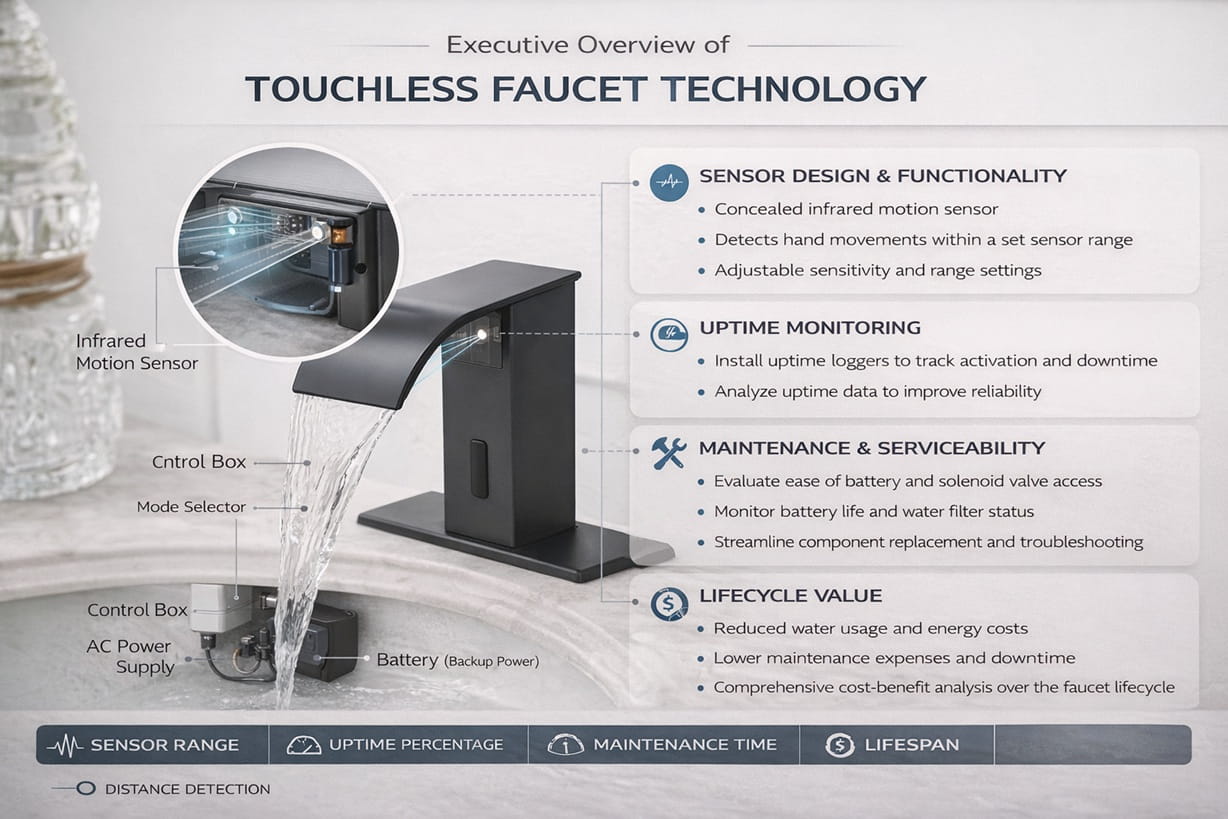
For executive teams, the real value of a touchless faucet is not limited to the purchase price. Performance over time has a direct effect on labor costs, water use, guest satisfaction, and the overall reliability of the building. A faucet that activates consistently, avoids nuisance triggers, and stays operational in wet, high-traffic conditions can reduce service interruptions across an entire portfolio.
This is where motion sensor design becomes a business issue instead of only a plumbing feature. Sensor placement, control-board sealing, power efficiency, and service access all influence whether a faucet becomes a dependable long-term asset or a repeated maintenance problem. In large hospitality, healthcare, and office environments, even small gains in uptime can produce meaningful savings over the life of the installation.
Decision-makers should also evaluate how well a system fits the realities of the site. Bright lighting, reflective finishes, humidity, and heavy daily usage can quickly expose weak engineering. The strongest touchless systems are the ones built to maintain detection accuracy, protect internal electronics, and simplify repairs when service is needed.
Reference Links
- Sloan Valve Company – Sensor Technology Overview (Technical Bulletin, 2019)
https://www.sloan.com - TOTO Ltd. – Optoelectronic Sensor Engineering in Touchless Faucets (White Paper, 2020)
https://www.toto.com - Symmons Industries – Ultrasonic vs. Infrared Sensing in Commercial Plumbing (Engineering Guide, 2021)
https://www.symmons.com - International WELL Building Institute – WELL Standard v2: Water & Sanitation Requirements (2022)
https://www.wellcertified.com - Texas Instruments – Low-Power Microcontrollers for IR Sensing
https://www.ti.com
