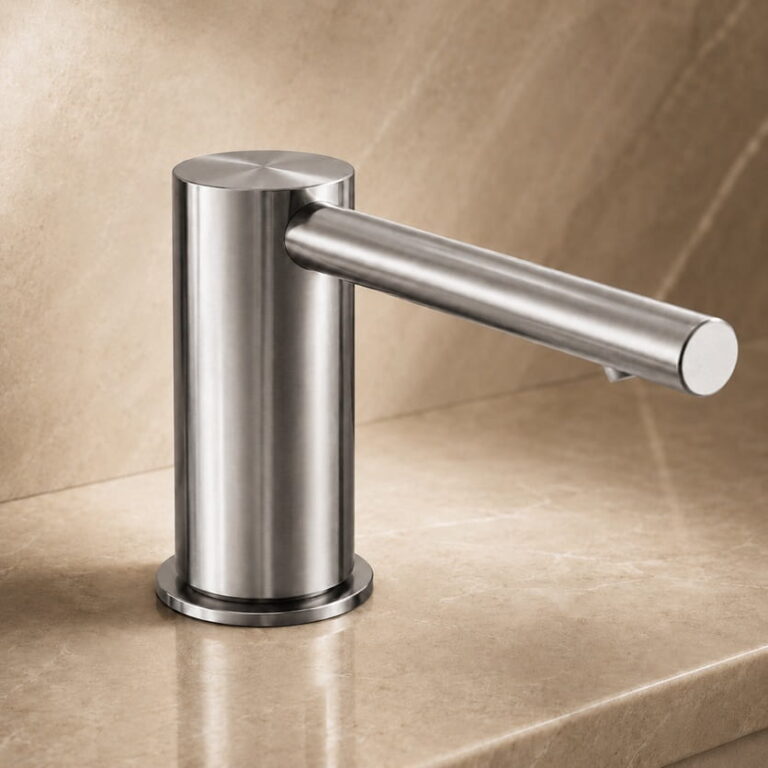

When an automatic faucet misses a hand, activates unexpectedly, or behaves differently from one sink to the next, the sensor is often blamed first.
That makes sensor reliability an important question. Traditional infrared proximity systems have decades of commercial use behind them, while Time-of-Flight sensing adds direct distance measurement to the control process.
So is ToF actually more reliable? In many short-range faucet applications, it can provide a more informative basis for activation. But the answer is more nuanced than simply declaring one technology universally superior.
ToF Can Improve Detection Reliability, but It Does Not Guarantee Faucet Reliability
Direct ranging gives the controller explicit distance information, which can help define a controlled activation zone. That can reduce dependence on reflected-signal strength alone. But overall faucet reliability still depends on sensor optics, firmware, power, solenoid response, valve sealing, hydraulic conditions and installation quality.
What Does “Reliable” Actually Mean for a Sensor Faucet?
Reliability is not one number. For a touchless faucet, several different behaviors matter.
Does the faucet detect an intended hand consistently?
Does the faucet avoid activating because of the basin, drain or nearby movement?
Does performance remain stable under humidity, water exposure and changing lighting?
Does the solenoid open and close correctly after the sensor makes a decision?
Does the faucet behave predictably under battery decline or power interruption?
Does the complete system continue performing after repeated commercial use?

The Core Reliability Difference: Signal Strength vs Distance
Presence Inferred From the Optical Return
In a simple reflective system, the controller evaluates returned infrared energy and determines whether the signal indicates that an object is sufficiently close.
This can work very well, but reflectivity, geometry and calibration may influence the strength of the returned signal.
Presence Evaluated With Distance Information
ToF determines target distance from the travel characteristics of emitted and returned light.
This gives the controller explicit spatial information that can be used to determine whether the hand is inside the intended activation window.
Traditional IR vs ToF: Reliability Factors at the Sink
| Reliability Factor | Traditional IR | ToF | Engineering Significance |
|---|---|---|---|
| Hand detection | Very capable when calibrated correctly | Very capable with direct ranging | Both can perform reliably in properly designed systems. |
| Distance awareness | Often indirect | Direct | ToF can define activation based more explicitly on spatial position. |
| Target reflectivity | Can strongly affect returned signal | Still relevant, but distance is the intended output | Important around dark basins, chrome drains and varied materials. |
| Zone control | Usually controlled through sensitivity, optics and geometry | Distance threshold can be part of control logic | Useful where the desired hand zone is compact. |
| Ambient light | Requires optical filtering and compensation | Also requires optical filtering and signal processing | ToF is not immune to optical environmental conditions. |
| Installation sensitivity | Important | Important | Mounting angle and basin geometry still matter for both. |
| Whole-system reliability | Depends on full faucet design | Depends on full faucet design | Sensor choice cannot substitute for valve and hydraulic validation. |

Reflectivity Is Where the Difference Becomes Practical
A commercial sink can contain surfaces with dramatically different optical characteristics.
A polished chrome drain can return a strong signal. A dark matte basin may return less. Water on the surface can alter reflections again.
A traditional reflective system may compensate through sensor geometry, sensitivity settings and signal processing. ToF adds another piece of information: the measured distance to the target.
That can make it easier for the control logic to distinguish “strong reflection” from “target in the correct location.”
Reliability Is Also About Knowing When Not to Activate
A faucet that always detects hands but also activates because of the drain, passing users or cleaning equipment is not truly reliable.
The sensing system must therefore solve two problems at once:
Detect the intended hand when a user actually wants water.
Ignore unintended targets outside the normal interaction zone.

The Sensor Can Be Reliable While the Faucet Is Not
This is the most important limitation in any IR-versus-ToF comparison.
The sensor only decides whether activation should occur. Water flow still depends on several downstream components.
A perfect sensor connected to an unreliable solenoid still produces an unreliable faucet.
What Should Be Tested Beyond Sensor Accuracy?
A serious reliability evaluation should extend well beyond whether the sensor detects a hand in a laboratory.
Confirm the intended operating zone and repeatability.
Check nearby devices, lighting and background conditions.
Verify opening and closing through the complete control system.
Protect electronics from the wet countertop environment.
Confirm valve and seal integrity under hydraulic loading.
Evaluate repeated activation and post-cycle performance.

Example of Finished-Faucet Reliability Validation
One useful way to judge reliability is to examine whether the manufacturer validates the complete faucet rather than relying on the specification of the sensing component alone.
Fontana’s documented finished-faucet procedure includes sensing, electrical, environmental and hydraulic checks such as:
| Validation Area | Documented Criterion |
|---|---|
| Sensing distance | 10–30 cm evaluation range with 12 cm preset target |
| Sensing angle | Less than 30° |
| Valve timing | Open ≤1 sec / close ≤1.5 sec |
| PCB waterproofing | IP67 |
| Humidity exposure | 40±2°C at 95±2% RH for 48 hours |
| Lifecycle testing | 200,000 activation cycles |

So Which Is More Reliable?
| Situation | Likely Advantage |
|---|---|
| Simple, predictable basin geometry | Traditional IR can be highly reliable and economical |
| Need for explicit short-range zone control | ToF has a meaningful technical advantage |
| Highly variable reflective environment | Distance-aware sensing deserves stronger consideration |
| Poor valve, weak power or poor installation | Neither sensor technology can compensate for system weakness |
| Large commercial fixture population | Prioritize whole-system evidence, repeatability and serviceability |
How Should Touchless Faucet Sensor Reliability Actually Be Tested?
For a deeper engineering framework covering detection, false activation, electrical behavior, moisture resistance, pressure, environmental exposure and lifecycle testing, review the complete reliability-testing analysis.
Compare ToF With Traditional IR in More Detail
See how direct distance measurement changes the sensing decision compared with reflected-signal proximity detection.
Performance & Specification Summary
Time-of-Flight does not make traditional infrared obsolete. A properly designed IR faucet can remain extremely reliable.
Where ToF becomes compelling is in the sensing decision itself. Direct ranging gives the controller explicit information about where the target is, which can improve control of a short activation zone and reduce dependence on reflected-signal intensity alone.
For commercial faucets, ToF can improve sensing reliability—but true faucet reliability still has to be proven from sensor to solenoid.

Nadia Ellison is a staff writer and editorial team member at autotouchlessfaucets.com. Her work focuses on sensor faucet technology, activation methods, power options, and commercial applications, helping transform manufacturer documentation, product specifications, published standards, and industry sources into practical guidance for specifiers and facility professionals.