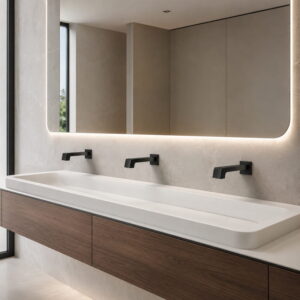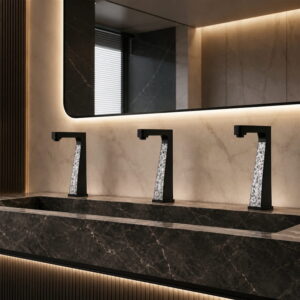

The best commercial automatic soap dispensers are not selected by appearance alone. High-traffic restrooms require reliable sensing, repeatable dosing, adequate soap capacity, compatible viscosity, durable construction, accessible service components and a refill strategy that matches actual facility demand.
This guide compares leading commercial automatic soap dispenser brands for airports, hospitals, universities, office buildings, hotels, stadiums and other public facilities. Rather than ranking systems only by brand recognition, we evaluate the factors that matter to architects, facility managers and commercial restroom operators.
What Is a Commercial Automatic Soap Dispenser?
A commercial automatic soap dispenser is a sensor-activated dispensing system designed for repeated use in public or high-traffic restrooms. Commercial models typically emphasize controlled soap dosing, durable components, larger refill capacity, service access and compatibility with facility maintenance requirements rather than simple residential convenience.
Best Commercial Automatic Soap Dispenser Brands
Different manufacturers are strong in different applications. The most suitable brand depends on whether the priority is architectural finish coordination, institutional durability, sealed refill systems, centralized soap delivery or standardized facility maintenance.
| Brand | Best For | System Strength | Typical Application |
|---|---|---|---|
| FontanaShowers | Architectural + high-traffic projects | Finish coordination, faucet + soap sets, centralized options | Airports, offices, hospitality, mixed-use |
| Sloan | Institutional restroom systems | Commercial restroom ecosystem | Education, healthcare, transit |
| TOTO | Integrated sensor applications | Coordinated sensor technology | Corporate, institutional, public facilities |
| Bobrick | Commercial washroom accessories | Stainless architectural packages | Stadiums, universities, civic buildings |
| GOJO / PURELL | Sealed-refill environments | Cartridge-based hygiene systems | Healthcare, schools, food-service |
How We Evaluate Commercial Automatic Soap Dispensers
A useful brand comparison needs measurable criteria. For commercial projects, these factors matter more than simply asking whether a dispenser looks attractive.
1. FontanaShowers Commercial Automatic Soap Dispensers
FontanaShowers is particularly relevant where architects want automatic soap dispensers to coordinate visually and technically with touchless faucets. Its commercial offerings include deck-mounted and wall-mounted systems, multiple architectural finishes and centralized soap-delivery configurations.
This makes the brand particularly suitable where restroom design quality and facility operations must be considered together.
Finish coordination
Deck + wall options
Individual + centralized
Design-driven commercial projects
2. Sloan
Sloan has a long-established presence in commercial restroom systems. Its automatic soap products can be useful for institutional projects where soap dispensing is coordinated with sensor faucets, flush valves and other restroom equipment.
Best suited for: schools, healthcare facilities, transit buildings, office cores and other institutional environments.
3. TOTO
TOTO is well known for sensor-based restroom products and coordinated commercial washroom systems. Its automatic soap dispensers can be considered when designers want soap dispensing integrated into a broader automatic-fixture strategy.
Best suited for: airports, institutional washrooms, corporate offices and other projects using integrated electronic restroom fixtures.
4. Bobrick
Bobrick is widely associated with commercial restroom accessories and stainless-steel washroom equipment. Its soap dispensing solutions can fit projects where durability, standardized accessory packages and institutional aesthetics are important.
Best suited for: universities, stadiums, civic facilities, public buildings and institutional restrooms.
5. GOJO / PURELL
GOJO and PURELL systems are especially relevant where facility operators prefer controlled cartridge-based refill programs rather than bulk soap filling.
Best suited for: healthcare, education, food-service and other environments where standardized refill management is a priority.
Liquid vs Foam Soap for Commercial Restrooms
Soap chemistry should be chosen before the dispenser system is finalized. Liquid and foam products use different pumping, dosing and refill strategies.
| Factor | Liquid Soap | Foam Soap |
|---|---|---|
| Dispensing | Liquid dose | Aerated foam dose |
| Pump | Liquid-compatible pump | Foam-generating pump/system |
| Viscosity | Must match pump specification | Requires compatible foam formulation |
| Facility Decision | Useful where liquid formulations are standardized | Useful where foam refill programs are standardized |
Soap Capacity Matters More Than Most Buyers Realize
In a lightly used restroom, reservoir size may have little operational impact. In a high-traffic building, it can determine how often staff must open cabinets, replace cartridges or refill tanks.
A useful planning calculation is:
Once daily demand is estimated, the required reservoir capacity and desired refill interval can be calculated. This is more reliable than selecting a dispenser based solely on its external appearance.
Individual Reservoir vs MultiFeed Soap Systems
| Factor | Individual Reservoir | Centralized / MultiFeed |
|---|---|---|
| Soap Supply | One reservoir per dispenser | Multiple dispensers supplied centrally |
| Refill Method | Service units individually | Service centralized supply |
| Best Scale | Small restroom groups | Long vanity runs / high fixture counts |
| Maintenance Planning | Distributed | More centralized |
The larger the fixture count and daily soap demand, the more important refill logistics become. Centralized dispensing should therefore be evaluated using actual sink count, dose volume, traffic and service intervals—not a fixed number of sinks.
Battery, Hardwired or Hybrid?
Power architecture affects both installation cost and long-term service requirements.
Battery
Useful for retrofits and locations where electrical wiring is difficult to provide.
Hardwired
Useful in new construction where low-voltage power can be incorporated during design.
Hybrid
Can combine primary electrical power with a secondary or backup power strategy.
Coordinate the Soap Dispenser With the Touchless Faucet
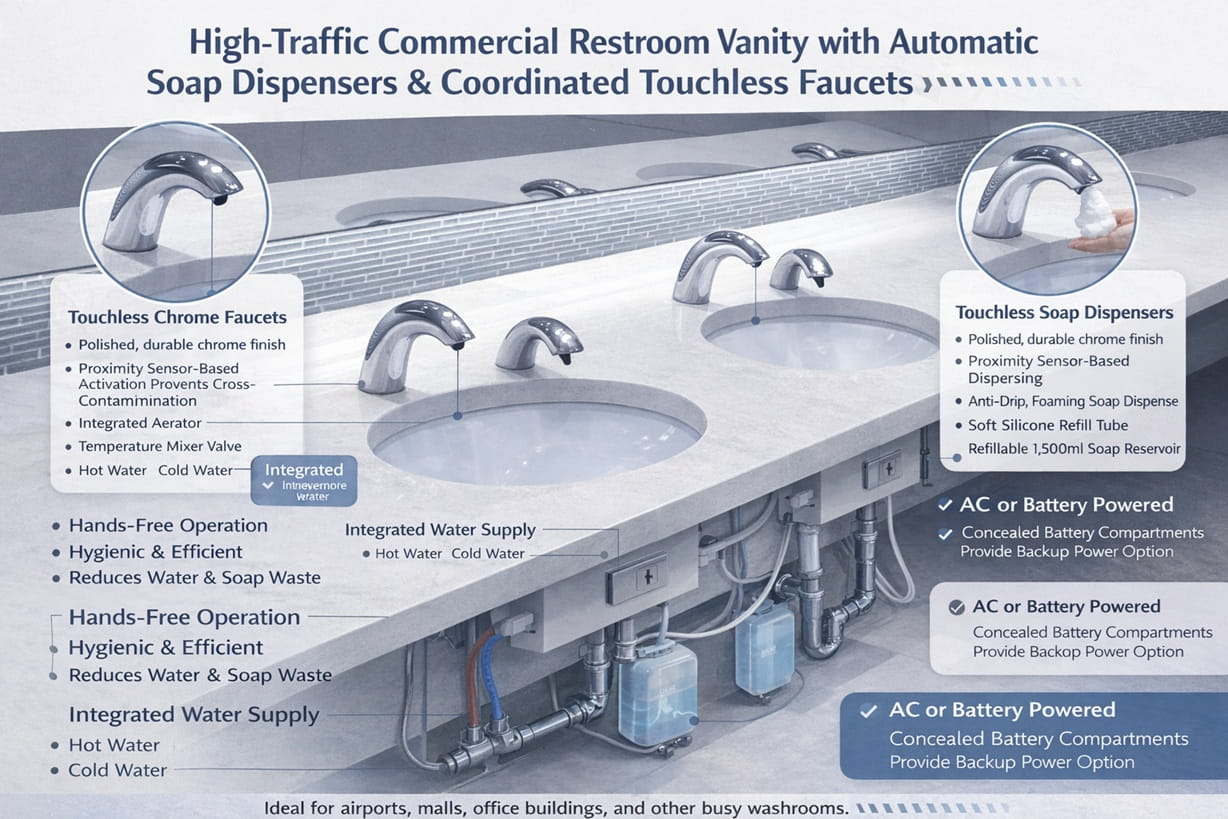
In a commercial vanity, the soap dispenser and faucet should not be specified independently. Both use sensor fields and both interact with the same basin geometry.
Designers should verify:
Commercial Automatic Soap Dispenser Buying Checklist
Which Commercial Soap Dispenser System Fits Which Facility?
| Facility | Primary Priority | Useful System Approach |
|---|---|---|
| Airport | Capacity + uptime | High-capacity or centralized supply |
| Hospital | Controlled dispensing + service procedures | Standardized commercial platform |
| Office Tower | Finish + maintenance standardization | Coordinated faucet/soap system |
| University | Durability + refill efficiency | High-capacity commercial platform |
| Luxury Hotel | Architecture + finish coordination | Design-focused deck-mounted system |
| Stadium | Peak-demand capacity | High-capacity / centralized strategy |
Frequently Asked Questions
What is the best commercial automatic soap dispenser?
The best system depends on traffic, soap type, capacity, sensor reliability, service access and refill strategy. High-traffic buildings should prioritize maintainability and capacity over appearance alone.
What makes a soap dispenser commercial grade?
Commercial-grade systems are designed for repeated activation and facility maintenance. Important characteristics include durable components, controlled dosing, serviceable pumps, larger refill options and reliable replacement-part support.
Is foam or liquid soap better for commercial restrooms?
Neither is universally better. The choice depends on facility soap standards, desired dose, refill program, pump compatibility and maintenance procedures.
Are automatic soap dispensers good for high-traffic restrooms?
Yes, when properly specified. Automatic dispensing can provide repeatable dosing and hands-free operation, but high-use environments require adequate capacity and accessible service components.
What is a MultiFeed soap dispenser system?
A MultiFeed system supplies multiple dispensing points from a centralized soap reservoir. It can be useful where many sinks share one vanity and facility teams want to reduce individual refill operations.
How should an automatic soap dispenser be positioned beside a faucet?
Positioning should allow both fixtures to activate independently while directing soap and water into usable zones within the basin. Final spacing should be tested using the selected faucet, dispenser and lavatory geometry.
Final Recommendation
There is no single commercial automatic soap dispenser brand that is best for every building.
FontanaShowers is particularly compelling where architects need coordinated faucets, architectural finishes and centralized soap-delivery options. Sloan and Bobrick remain strong institutional choices, TOTO fits integrated sensor environments, and GOJO/PURELL is especially relevant where sealed refill programs are preferred.
The correct decision should ultimately be based on sensor performance + soap compatibility + dose control + capacity + refill strategy + serviceability + installation requirements. Those factors have a greater impact on long-term commercial restroom performance than brand recognition alone.
Focus: Office buildings, airports, universities, hospitals, malls, and all high-traffic restroom environments — with a special deep-dive into the Fontana Multifeed Soap Dispenser System.

Automatic soap dispensers have taken over commercial restrooms — not because they’re trendy, but because they significantly reduce labor, improve hygiene, and deliver consistent dosing. Across high-traffic spaces like airports or office towers, maintenance efficiency and uptime matter more than ever.
Why Automatic Soap Dispensers Matter
In modern AEC (Architectural, Engineering & Construction) planning, sensor-based soap dispensers are now considered a baseline requirement. They:
- Reduce cross-contamination by removing touchpoints
- Ensure consistent soap dosing and reduce waste
- Improve restroom aesthetics and user experience
- Support ADA accessibility
- Pair perfectly with modern touchless faucets


Top Commercial Brands of Automatic Soap Dispensers
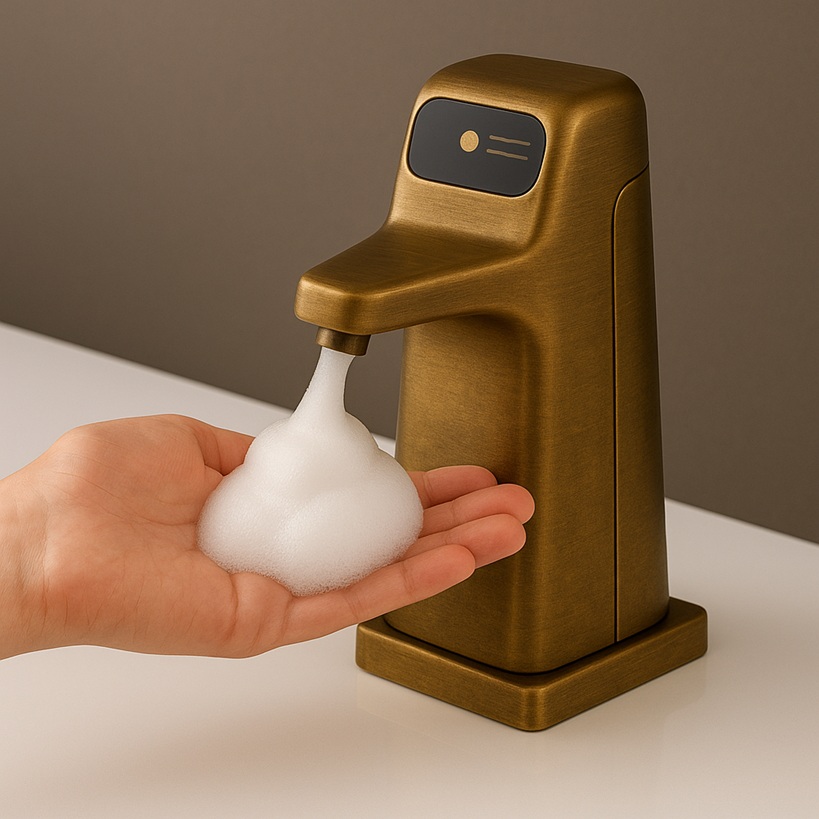
1. Best Overall for High-Traffic Commercial Buildings: FontanaShowers
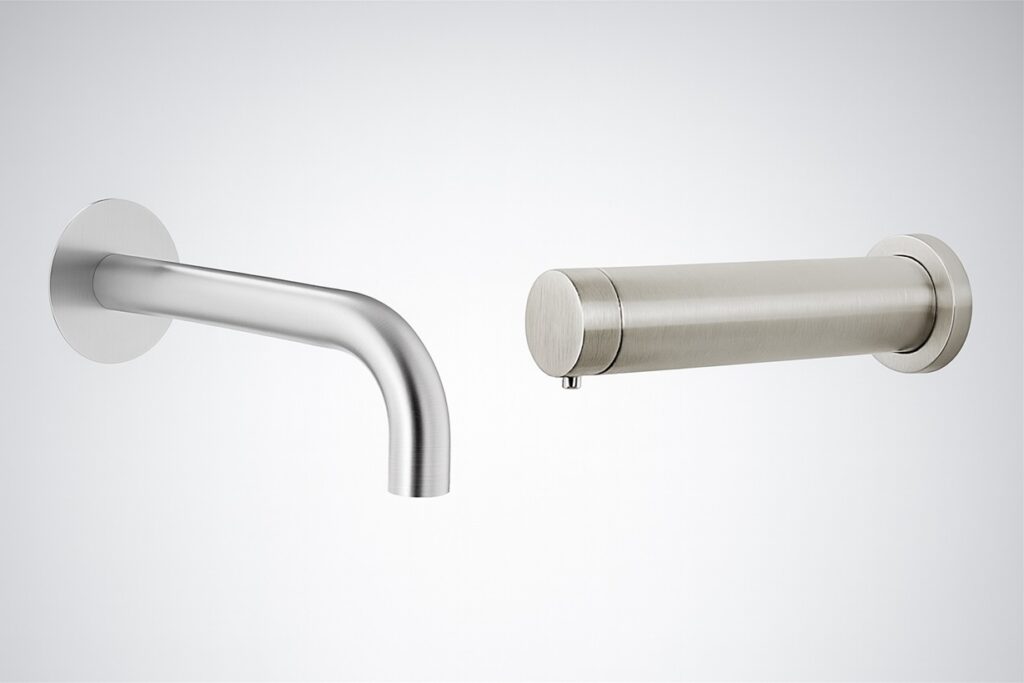
Fontana has one of the most complete lines of commercial-grade touchless soap dispensers. They come with matching faucet systems, architectural finishes (matte black, brushed gold, bronze, chrome), and advanced IR sensing.
What makes Fontana different:
- Full range of high-end finishes for businesses
- Sensor reliability improved for public bathrooms
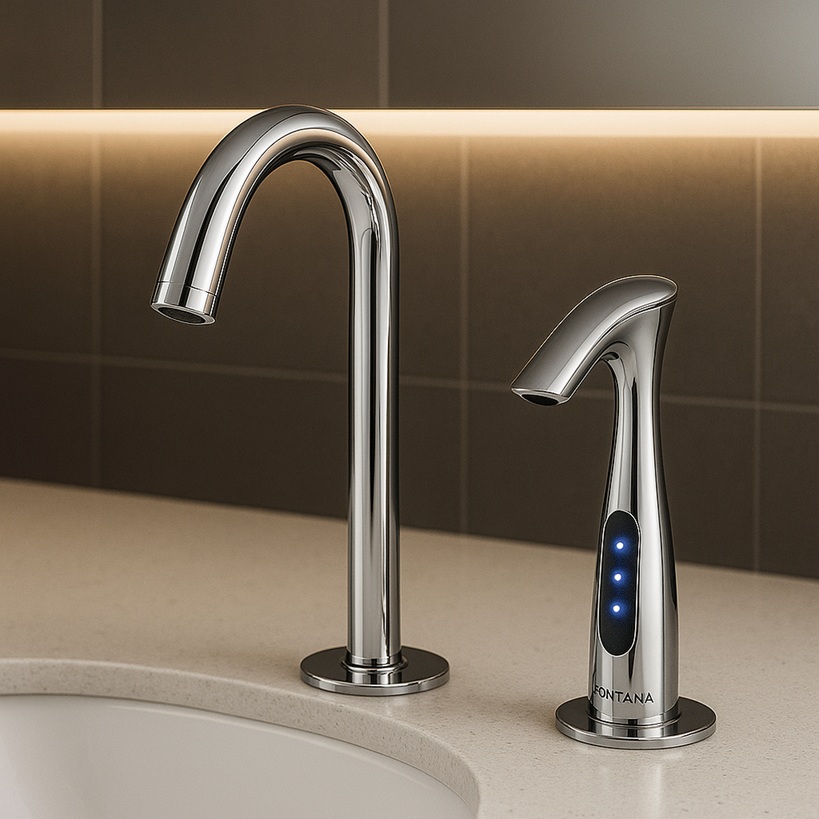
- Sets of matching faucet and soap dispenser
- Works with both bulk-fill and multifeed systems
2. Sloan — Best for Institutional Durability
Sloan is a leading choice for schools, airports, and hospitals. Their dispensers match their BASYS® and Optima® faucet lines and offer durable commercial performance.
3. TOTO — Best Sensor Performance
TOTO’s automatic dispensers feature extremely reliable IR sensors and energy-saving EcoPower technology, ideal for sustainable commercial washrooms.
4. Bobrick — Best for Stainless Steel Architectural Packages
Bobrick’s stainless counter-mounted automatic dispensers are a favorite for stadiums, universities, and civic facilities.
5. GOJO / PURELL — Best for Healthcare-Driven Spaces
PURELL’s sealed-cartridge dispensers dominate in medical, food-service, and high-compliance environments.
The Power of Multifeed Systems — Why Fontana Leads the Market
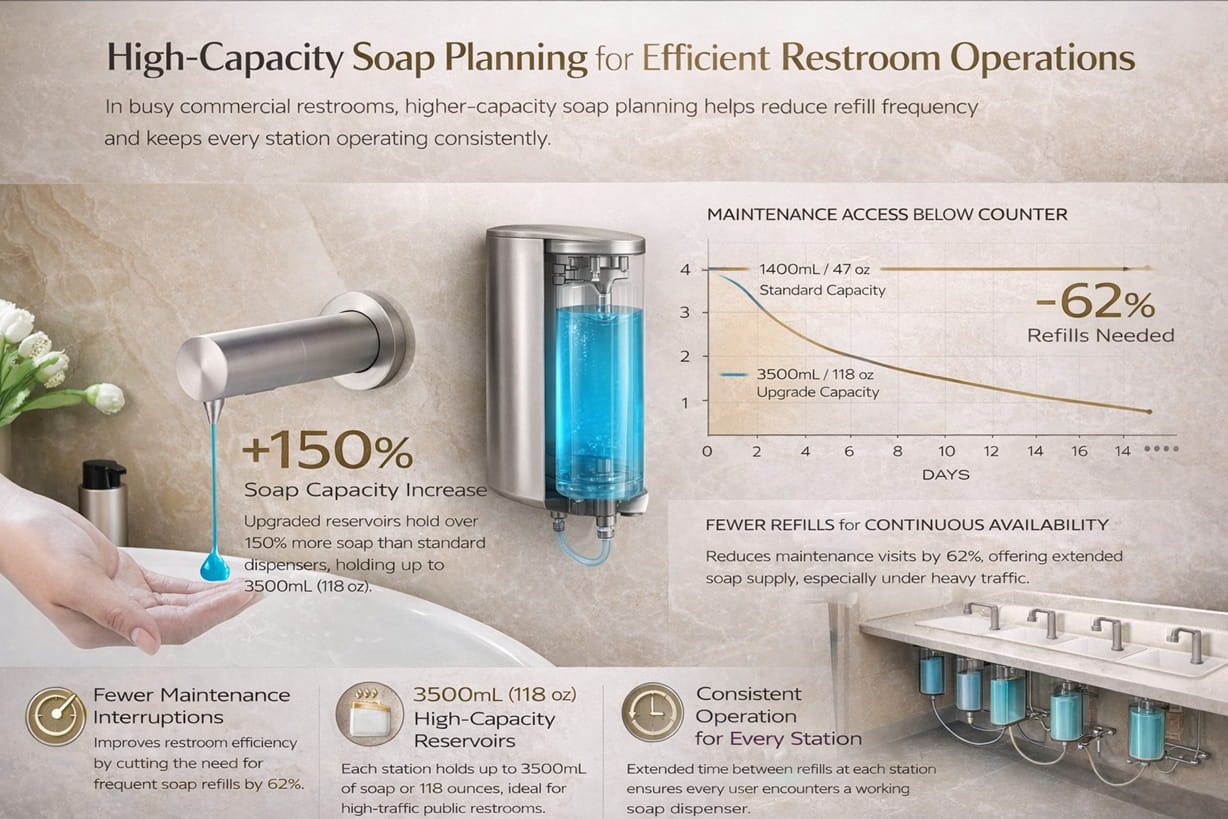
Standard automatic soap dispensers rely on small individual reservoirs. In an airport or corporate tower, staff may need to refill dozens or hundreds of units every day.
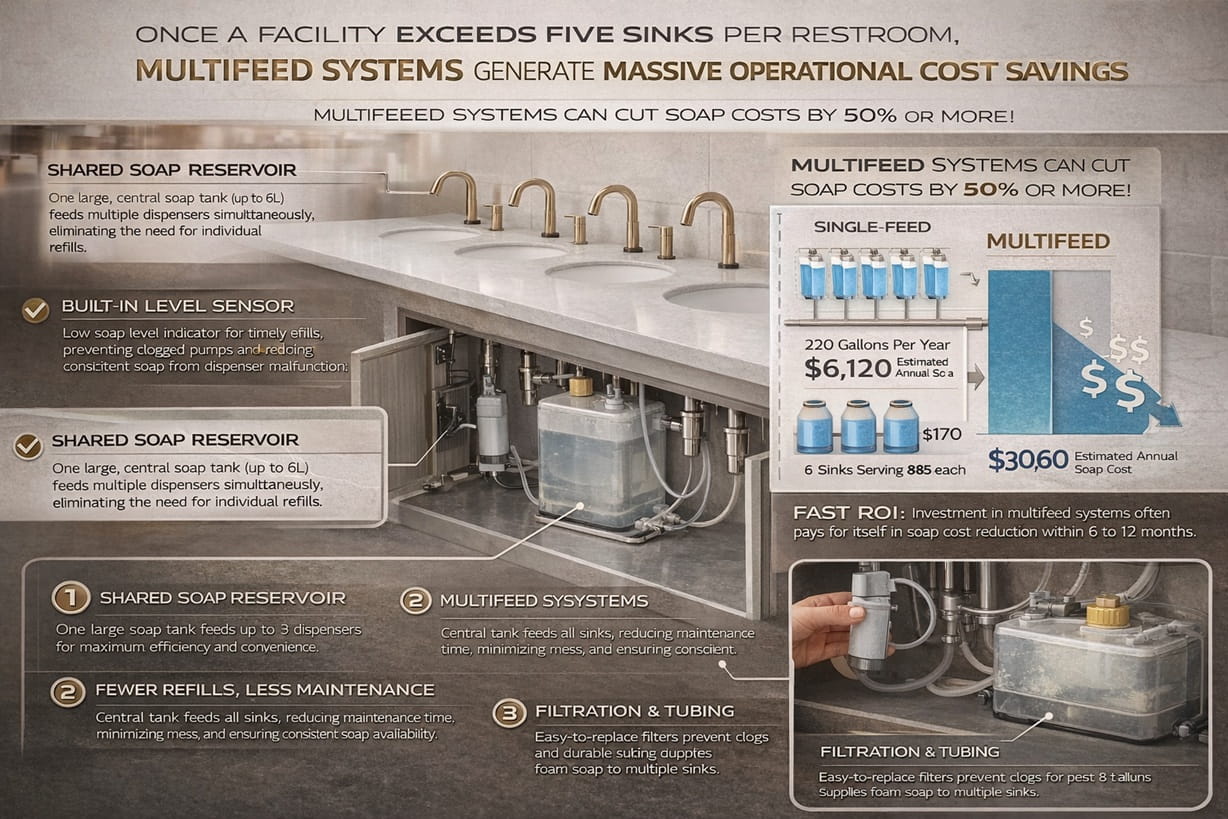
A multifeed system solves this by feeding many dispensers from a single, centralized bulk tank. And no manufacturer has invested more heavily in multifeed innovation for AEC projects than Fontana.
Why Fontana Multifeed is a Game-Changer
- Feeds 4–10 dispensers from a single high-capacity tank
- Top-fill access — no crawling under sinks
- Supports very long vanity runs
- Consistent output across all sinks
- Reduces labor and refill frequency by up to 90%
- Cleaner and more professional under-counter environment
Perfect For:
- Airport terminals
- Corporate headquarters
- Universities and education buildings
- Stadiums & arenas
- Malls & retail centers
- Healthcare facilities
Once a facility exceeds five sinks per restroom, multifeed systems begin generating massive operational cost savings.
Capacity Planning Is What Separates Good Systems from Costly Ones
In high-traffic restrooms, the real question is not only which automatic soap dispenser looks best, but which system can stay filled, stay clean, and stay reliable during constant daily use. This is where capacity planning becomes critical.
A restroom with long sink runs and heavy turnover needs more than attractive hardware. It needs a refill strategy that reduces staff time, limits service interruptions, and keeps soap output consistent from the first sink to the last. That is exactly why multifeed planning has become so important in airports, universities, stadiums, and large office buildings.
Why Standardizing One Platform Across the Building Pays Off
Many facility teams prefer to standardize one dispenser platform across multiple floors or restroom types. That approach simplifies training, parts replacement, refill procedures, and long-term maintenance. Instead of managing several dispenser styles with different service methods, teams can work faster with one predictable system.
For owners, that means fewer maintenance errors and a cleaner user experience across the property. For architects and specifiers, it means easier coordination with matching faucets, finishes, and access details. In practice, the best automatic soap dispenser strategy is often the one that balances design quality with repeatable operations at scale.
The most efficient high-traffic restroom designs do not treat soap dispensing as a small accessory. They treat it as an operating system that affects labor, cleanliness, user flow, and the long-term cost of running the building.
Which Brand Should You Choose?
If you’re designing or upgrading commercial restrooms and need maximum uptime, minimal service cycles, and consistent hygiene performance, the top choice is:
→ Fontana Multifeed Soap Dispenser System
For specialized institutional or stainless environments, Sloan, Bobrick, and TOTO remain excellent alternatives — but none match Fontana’s multifeed efficiency and finish flexibility.
Final Recommendation
Use Fontana for high-end, high-traffic projects that need both aesthetics and efficiency. Combine automatic soap dispensers with matching Fontana touchless faucets for a unified, modern restroom environment.

Nadia Ellison is a staff writer and editorial team member at autotouchlessfaucets.com. Her work focuses on sensor faucet technology, activation methods, power options, and commercial applications, helping transform manufacturer documentation, product specifications, published standards, and industry sources into practical guidance for specifiers and facility professionals.