Engineering History
Infrared vs Ultrasonic Faucet Sensors: How Touchless Detection Evolved
Touchless faucet technology is now standard in commercial bathrooms, hospitals, hotels, airports, and increasingly in homes as well. There is a long history of advanced engineering behind those polished chrome exteriors. This history is built on two main detection methods: infrared (IR) sensing and ultrasonic sensing. These systems have changed significantly over the last 30 years. They have evolved from simple analog circuits into smart, self-adjusting, digitally calibrated modules designed to be accurate, reliable, and efficient.
This piece will outline how IR and ultrasonic faucet sensor technology was created, problems they solve, and new emerging technologies being used in their design.

Early Beginnings: The Need for Reliable Hands-Free Activation
Hands-free faucets originated from three primary market drivers:
- Hygiene: Keeping healthcare and food-service environments clean and safe from germs.
- Water Savings: Automated shutoff eliminates human behavior-based waste.
- Operational Efficiency: Faucets that regulate themselves reduce maintenance and misuse.
The first commercial touchless faucets, which came out in the late 1980s and 1990s, used mostly simple IR proximity sensors. These early systems worked well, but they weren’t smart. Changes in light, the reflectivity of the basin, and sensor drift often set them off by mistake.

Infrared Sensors: The First Generation
How Early IR Sensors Worked
Traditional IR sensors use:
- An IR LED emitter sending a narrow beam downward.
- A photodiode or phototransistor receiver detecting reflections from a user’s hand.
When the reflected IR signal crosses a threshold, the solenoid valve opens.
Engineering Challenges
Early IR faucet systems faced several reliability issues:
- Ambient Light Interference: The sunlight present in the room caused interference in the detection.
- Reflective differences: Dark-skinned people were reflected less IR, leading uneven activation.
- Fixed calibration: The sensors were calibrated manually.
- Limited field of detection: The user was required to place the hands in the correct location.
Important Technological Advancements
The period from the early 2000s to the mid-2010s saw the improvement of IR sensors through advances in the following:
- Modulated IR signals
The sensors started emitting IR at specific frequencies, allowing them to ignore irrelevant IR from other light sources. - Dual-photodiode arrays
Wider detection zones improved accuracy and user friendliness. - Electronic gain adjustment
Automatic compensation for different basin materials and lighting. - Low-power microcontrollers
Enabled battery-operated faucets to run for years on AA cells. - Sealed optical chambers
Improved water resistance and reduced sensor window fogging.
By 2015, IR sensors could be switched on and off very reliably and required very little maintenance.

Ultrasonic Sensors: Expanding the Technology Frontier
Ultrasonic sensing entered the faucet industry as a solution to IR’s limitations. Ultrasonic sensors detect motion using high-frequency (typically 40 kHz) sound waves rather than light.
Why Ultrasonic Sensors Emerged
Ultrasonic technology solved problems inherent to IR:
- Works independently of ambient lighting.
- Detects a wider range of materials (skin tones, gloves, contaminants).
- Offers broader detection fields.
- More tolerant to reflective or matte sink surfaces.
These advantages made ultrasonic faucets attractive for hospitals, manufacturing facilities, and high-precision environments.

Engineering Principles of Ultrasonic Faucet Sensors
A typical ultrasonic faucet sensor includes:
- A piezoelectric transmitter generating ultrasound pulses.
- A receiver measuring reflected sound waves.
- A microcontroller performing time-of-flight (TOF) calculations.
TOF is the time it takes for a pulse to return—a shorter TOF means an object (like a hand) is close.
Challenges in Early Ultrasonic Systems
Despite advantages, early ultrasonic faucet sensors faced issues:
- Noise pollution from industrial equipment.
- Condensation inhibiting the transducer resonance.
- Short battery life, as it will consume more power.
However, advances in DSP technology helped reduce some of those weaknesses.

Convergence: Hybrid Sensor Technologys
Present-day high-end touchless faucets use dual sensors, which integrate the benefits of infrared technology and ultrasonic sensors in the following manner:
- IR provides precision within a short distance.
- Ultrasonic adds a wider detection zone and environmental stability.
Hybrid systems significantly reduce false activation and improve trigger reliability in public environments.
AI-Enhanced Detection
From 2020 onward, microcontrollers with embedded machine-learning algorithms enabled:
- Adaptive environmental calibration
- Dynamic detection field adjustment
- Self-diagnostics for reduced maintenance
- Predictive battery-life estimation
This marks a major shift from simple reactive sensors to proactive, intelligent hardware.
Miniaturization and Waterproofing Breakthroughs
Modern faucet sensors benefit from advancements in:
System-on-Chip (SoC) Integration
Combining emitter, receiver, and signal processing into one chip reduces:
- PCB size
- Power consumption
- Heat generation
- Manufacturing cost
Ingress Protection (IP) Improvements
Sensors now commonly achieve IP67 or IP68 ratings, using:
- Potting compounds
- Gaskets and O-rings
- Nano-coatings – Hydrophobic
This dramatically enhances durability in high-moisture environments.
Power Efficiency and Energy Architecture
Traditional sensor modules consumed a power in the range of 300–600 mW, but modern designs use:
- Adaptive duty-cycle algorithms
- Ultra-low power MCUs-up to 10–30 µA in idle mode
- Efficient Solenoid Valves
- Supercapacitor assist circuits for peak loads
For example, battery-operated faucets have worked their way up to 4–8 years of service life from 1–2 years in their early version.
Industry Trends Driving the Future of Sensor Faucets
Smart Building Integration
More faucets are connecting to building management systems (BMS) using:
- Bluetooth Low Energy
- LoRaWAN
- Wi-Fi modules
Facilities can monitor:
- Usage frequency
- Water consumption
- Remaining battery life
- Fault history
Environmental Sustainability Requirements
Regulatory pressure (e.g., LEED, WELL Building Standard) drives:
- Lower flow rates
- Smarter shutoff algorithms
- Multi-stage sensing strategies
Predictive Maintenance and IoT
Sensors now detect:
- Clogged aerators
- Stuck valves
- Sensor lens contamination
- Declining performance
This supports preventive maintenance instead of emergency reactive repairs.
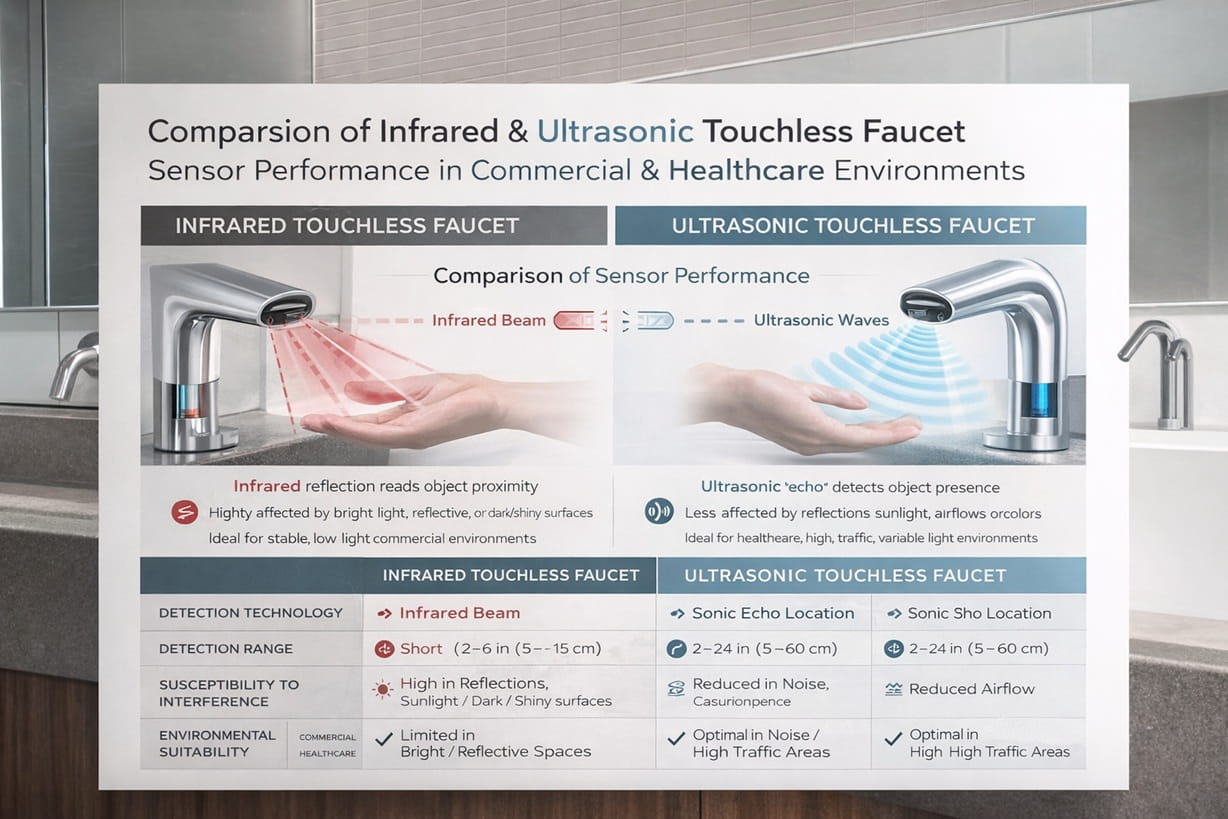
Comparative Engineering Overview
| Feature | Infrared Sensors | Ultrasonic Sensors |
|---|---|---|
| Sensitivity to light | High | None |
| Material detection accuracy | Moderate | High |
| Power consumption | Low | Moderate |
| Range | Short to medium | Medium to long |
| Best application | Public restrooms, hotels | Hospitals, industrial sinks |
| Cost | Lower | Higher |
How Sensor Choice Affects Real-World Performance
In daily use, the difference between infrared and ultrasonic sensing is not only technical. It affects how natural the faucet feels, how often false activations happen, and how much maintenance a facility team may need to handle over time. Infrared systems remain common because they are compact, efficient, and cost-effective for many public restrooms and residential settings.
Ultrasonic systems add value where the environment is more demanding. In spaces with changing light, reflective surfaces, gloves, or heavy traffic, the broader detection behavior can improve consistency. That is why ultrasonic and hybrid sensor designs are often discussed for hospitals, laboratories, and other locations where dependable activation matters more than keeping hardware costs low.
For buyers and specifiers, the best approach is to match the sensing method to the environment. A well-designed infrared faucet can perform extremely well in the right setting, while a hybrid or ultrasonic setup may be the better long-term choice where conditions are less predictable. The most important goal is reliable activation, controlled water use, and easy serviceability over the life of the faucet.
Conclusion
Infrared and ultrasonic faucet sensors are being made in a way that is similar to how other new technologies in embedded electronics, optoelectronics, and smart building automation are being made. Touchless faucet technology has come a long way since the early IR circuits that had trouble with changing light levels. Today, there are sensor modules that are hybrids, use AI to help them calibrate themselves, and are self-calibrating.
The next generation will likely feature:
- Fully IoT-integrated sensor networks
- Harvesting energy from water motion
- Smarter multi-modal detection, integrating IR, ultrasonic, and time-of-flight cameras
Smart buildings and a focus on sustainability are fast becoming a reality. This will mean a transformation for faucet sensors—away from being basic proximity sensors to fully functional micro-systems.
References

Nadia Ellison is a staff writer and editorial team member at autotouchlessfaucets.com. Her work focuses on sensor faucet technology, activation methods, power options, and commercial applications, helping transform manufacturer documentation, product specifications, published standards, and industry sources into practical guidance for specifiers and facility professionals.